
Category: Escape the matrix

  • Blog 116

    Blog 116

    Ready.

    Review of The Harder They Come

    B. Lorenzo Buckinchere

    Jul 26, 2026

    It’s the end of the month, and time once again for our monthly review series. Our muse for the month of July is Ivanhoe Martin from The Harder They Come.

    But before we begin, here’s a disclaimer.

    Disclaimer:

    The following review contains spoilers, and is subject to interpretations that may not express the perspectives, or intentions of the creators. Please watch the film in its entirety before reading this, or any other reviews on the topic.

    Now without further ado, let’s begin.

    Overview:

    The Harder They Come is a 1972 Jamaican crime film co-written by Trevor Rhone and Perry Henzell, produced by International Films Management, Ltd.

    It is loosely based on the life of 1940s Jamaican criminal, Vincent “Ivanhoe” Martin (better known as Rhyging), and stars legendary reggae singer, Jimmy Cliff.

    Plot:

    In 1972, Ivanhoe “Ivan” Martin (Jimmy Cliff) was a typical country-come-to-town youth of that era. As soon as he arrived in Kingston, he was tricked by a random hardcart vendor, played by Volier “Maffy” Johnson.

    He asked around and soon found out where his mother (played by Lucia White) resided, and went to visit her. He told her that her mother died and sold the house, and gave her what remained of the money.

    Right from the jump, her attitude towards him was very neglectful, and she told him he cannot stay with her in Kingston, so he should go back to rural Jamaica. But Ivan was determined to make it big as a singer in Kingston, so his mother gave him the number for a local preacher (played by Basil Keane).

    With nowhere else to spend his first night in town, Ivan went to see a show with some of the guys in the tenement yard where his mother had resided. It was a western, and some of the movie patrons were seen jeering and yelling at the screen, “hero no dead till the end.”

    Over the next few days, Ivan, who was essentially homeless and sleeping at bus stops, asked around for several odd jobs, but was rejected on every occasion.

    Eventually, the preacher gave him a car repair job in a nearby junkyard, and it wasn’t long before Ivan wooed the preacher’s daughter, Elsa (Janet Bartley). But there was trouble.

    One of the other men who worked in the junkyard would always disparage Ivan, but he pushed it too far when he stole Ivan’s bicycle.

    Ivan used a knife to slice up his co-worker’s face in a fit of rage, showing his first propensity towards violence, at only 30 minutes into the film. The judge sentenced him to be publicly lashed with a tangerine whip, and he was lashed until he ended up peeing on himself.

    Then there was a “Mr. BigStuff” type record producer in town named Hilton (Bob Charlton), and Ivan had the opportunity to audition for him when the preacher sent him to deliver a record.

    He performed an earlier rendition of the Harder They Come, but he didn’t quite make the cut. So he asked Elsa if she could lend him the key to her father’s church, so he and some friends could practice after dark.

    Elsa was rather apprehensive about lending Ivan the keys for fear of betraying her father, but Ivan told her that she was a grown woman, and that she had to choose between him and the preacher.

    Elsa ended up lending him the keys, but they were soon caught by the preacher who got upset and threatened to call the police until Ivan’s friend, Jose (Carl Bradshaw), mentioned that they had a key. He went straight to Elsa whose confession was as bold as it was immediate, and he slapped her, which caused her to run away with Ivan.

    Ivan perfected his single and it became a hit, but Hilton was only willing to pay him JMD $20 (JMD $1000 in 2026). Knowing his worth, Ivan refused and wanted to branch out as his own producer, but Hilton controlled the market, and no one would buy any records, or play the song on air unless Hilton gave the word. So Ivan was forced to sell his song for a measly $20, which he did, believing the popularity of his first hit would lead to other songs.

    He invited Elsa to a party, but she didn’t even have enough to buy food after a long day of job hunting. Ivan lost his patience with her and told her that her father had indoctrinated her into accepting that her slice of the pie was waiting for her in the sky when she died, but he wants his share now on earth.

    Then he left and attended the dance without her.

    Then there were a couple of drug smugglers on the music scene, and before long, Ivan, the quiet country-come-to-town youth, got caught up in a life of crime. Before he knew it, he was delivering packages to ganja smugglers in private planes.

    After one of them got caught in Miami, Ivan read in the newspaper that over $100,000 was seized, and decided he wanted a bigger cut. After a while, he started asking too many questions, which led to him being labeled a “troublemaker,” so they decided to “teach him a lesson.”

    Before long the police officer who once turned a blind eye to him riding his bike was suddenly chasing him. Remembering the humiliation from peeing on himself while being publicly whipped, he pulled out a gun and shot the officer off his bike.

    Ivan became a fugitive after he gunned down three more police officers during a raid on his home later that night as he copulated with his wife. He soon gained a lot of respect in the community after he chased the double-crossing police informant out of town, firing shots after him while all the locals gathered around him atop a bridge. Some of the locals soon started hiding him from the police.

    Jose told him about a plan to smuggle him off to Cuba, but Elsa tipped off the police about the plan, as well as where they’d planned to meet. Both Jose and the police were headed to Ivan’s whereabouts.

    Across the Kingston Harbour, over by the Palisadoes, Ivan was laying low, hiding out in the bushes when he spotted his boat. He swam out towards the boat, and they tossed down the ladder and told him to climb. But they soon spotted the police and sailed away, leaving him behind.

    He swam back to shore and the police soon docked ashore, and began their guerilla raid on the sandspit. Hiding in the bushes, he spotted them first.

    He was armed.

    Then they spotted him.

    They too were armed.

    He engaged in a shootout with the police while the jeering of the audience at the show from his first night in town came back to mind, “hero no dead till the end.”

    Outmanned and outgunned by the police, Ivanhoe Martin, the country-come-to-town youth who came hard from the bowels of desolation and desperation to becoming one of the single most notorious criminals of his time, ended up falling hard in the end.

    Review:

    I feel like Ivan never really had a chance to begin with. Too many forces were against him. From his neglectful mother, to a corrupt record producer, and all the working parts in between, he was destined to turn to a life of crime if he wanted his share on earth.

    There is also something to be said about human nature and their innate fear of you doing better than them often leading to betrayal.

    In the end, it was his woman who tipped off the police, and if people have not evolved past their base-level drive, then you can expect that they would turn against you when they notice that you are becoming too powerful within your own right, even if it’s not in their lane.

    Keeping in mind that this film is well over fifty years old, and considering his time and place, I believed that Ivan would have stood a better chance if he’d lived today, than he did back then.

    What, with the advent of AI and VPN? Every nook and cranny of modern Jamaica now has wi-fi. It would then be up to him to figure out the rest.

    Trivia:

    This crime picture was Jamaica’s very first feature film, and was also a musical. It featured some of Cliff’s most famous songs, including; You can get it if you really want, Many rivers to cross, as well as the titular, The Harder They Come.

    It also featured songs by other artists, such as; 007 (Shanty Town) by Desmond Dekker.

    The house wife at the beginning who asked her children “who left the gate open” was played by Beverley Anderson-Manley who was then the First Lady of Jamaica.

    Manley went on to co-hosting the Breakfast Club with Anthony Abrahams on KLAS FM 89 during the 1990s. They hosted the Breakfast Club each weekday morning at the Jamaica Pegasus Hotel in Kingston because KLAS was in Mandeville.

    The radio announcer playing The Harder They Come when it became a hit was none other than legendary broadcaster Don Topping. Topping has enjoyed a lengthy career in broadcast spanning decades. He, along with other radio greats such as Marie Garth, and the late Alan Magnus, is a part of the fabric of the golden years of Jamaican broadcast.

    The Cuban smugglers flying planeloads of drugs to Miami must have inspired the late actor Munair Zacca in his portrayal of Sonny T on the hit 1990s Jamaican soap opera, Royal Palm Estate, though R.P.E. itself is loosely based on Children of Babylon (1980) by Lennie Little-White.

    The Harder They Come was hosted by Professor Mychal Odom at the San Diego Public Library on February 17, 2026 as part of Black history month.

    It was the first time I ever saw it, and it gave me a little slice of home all the way in California. A proud moment indeed.

    This coming Thursday on July 30th would have been Jimmy Cliff’s 82nd birthday. Cliff was born James Chambers on July 30, 1944, and died November 24, 2025, aged 81.

    Verdict:

    This picture was well received at the time of its release, and is every bit as relevant today as it was back in 1972. I give this one a five out of five repaired bicycles, and I’ll see you on the next one.

    © 2026 The Buckinchere Publication, SP.

    All Rights Reserved.

    In the context of Jimmy Cliff's The Harder They Come, do you believe that Ivan Martin was a product of his time and place?
  • Blog 115

    Blog 115

    Ready.

    Keeping up with the idiots

    B. Lorenzo Buckinchere

    Jul 19, 2026

    Ever heard of luxury poverty?

    The act of appearing wealthier, or otherwise more important than others through materialistic possessions, and a false sense of comfort, versus having real power?

    Except that before I’d issued the Buckinchere Wager, people were referring to it as peacocking.

    If you go to a place, such as NYC’s Times Square, or LA’s Hollywood and Highland on a Saturday night, you will see normies out and about, seeking attention by appearing rich for a night.

    That is what is known as peacocking.

    Every city in all the history of mankind has its designated peacock zone. Whether it was the brothels of ancient Corinth, or Athens, or the club scene of every modern city in the world, peacocking is one of the most active moving parts of the social game, and is really just one giant dick measuring contest.

    Both genders practice peacocking.

    Male weapons of choice include, but are not limited to; cars, women, motorcycles, money, clothes, chains, etc.

    Female weapons of choice include, but are not limited to; shoes, cosmetics, purses, the male gaze, or male attention. Cars and money are secondary.

    Peacocking is particularly unwise, because egos tend to flare in those situations, and booze and sex is like dousing the flames with gasoline. In some countries such as Brazil and Colombia, where masculinity can be truly toxic, peacocking is dangerous enough to get you killed.

    Peacocking is mostly intra-gendered, but it can also be inter-gendered. It can occur among couples, and within friend groups.

    Speaking of friend groups, peacocking, though highly concentrated in certain city zones, is not confined to them.

    Peacocking can take place in the PTA at your son’s school, or in your HOA.

    Enter Karen.

    But you wanna know where peacocking is notorious for taking place the most?

    At work!

    The workplace is a marketplace where people go to compete with each other for resources, and measure their self-worth with the resources that they were able to gather, compared to what others in the workplace have.

    The competition is so intense, that they will literally set you up to get fired for simply buying a car.

    Jealous co-workers be like, “We’ll see how much you like your new car once you end up living in it.”

    Whether you work white-collar or blue-collar, the workplace is a melting pot of people from all different backgrounds, and different mindsets who are performing neuro-typicality for a paycheck.

    The culture becomes toxic when you have egos flaring due to a cocktail of insecure people competing for resources, and everybody wants to be the “It” factor. That’s usually when management starts picking favorites, and punishing the hard worker who simply does their job and goes home.

    And as if that wasn’t enough, the peacocking game doesn’t end when you clock out of your shift at 5 O’ clock.

    As soon as you walk in the door when you get home, your wife tells you, “we’re having dinner over at the Joneses tonight.”

    And you’re like, “Again? We just had dinner with them last week.”

    Your wife insists, and threatens to have you sleeping in the dog house again, when all you want to do is kick back with a beer and watch the game.

    You already know that dinner at the Joneses will be nothing more than a massive ego fest about the new car they just bought, or about Mrs. Jones’s new purse.

    What follows next is an existential crisis. You start looking back on your life, and re-assessing your life choices.

    Is the suburban home in the HOA, and the job status, and the car really worth playing this stupid dick measuring contest and keeping up with the Joneses? Would you have actually been happier living as a minimalist in a one-bedroom?

    You never asked for much. All you ever really wanted was health and financial stability. Perhaps to hang out with your buddies, playing acoustics in your garage at 2 AM.

    You look in the mirror, and you notice that you’re not getting any younger. It was only yesterday you were playing soccer with some of the neighborhood kids.

    But now, you notice a bald spot, and another existential crisis kicks in, the undefeatable biological clock we all must face.

    Then you see one of your co-workers, a younger man who is so happy with so little, and… you hate him.

    “Who does he think he is?!”

    Before you know it, you are joining the others in setting him up.

    You have become the very villain you despise!

    You have it all, yet you’ve never been unhappier because it’s still not enough.

    But what did you really expect?

    After all, it was just a stupid game of peacocking. You chose to play the social game when you should have been playing the power game instead.

    Remember, peacocking is really just the act of reinforcing luxury poverty by going into debt to purchase things you don’t need to impress people who don’t care.

    Some of these people are deeply flawed. Almost all of them wish they were in your shoes. Yet here you are feeling inadequate without their approval.

    But power has many forms after all. Including the power of freedom and peace of mind.

    So what do you ultimately choose?

    Keeping up with the idiots? Or competing with your mirror image?

    © 2026 The Buckinchere Publication, SP.

    All Rights Reserved.
    I would much rather purchase things because they make me:
  • Blog 114

    Blog 114

    Ready.

    Turnover Friendship??

    B. Lorenzo Buckinchere

    Jul 12, 2026

    Your co-workers are not your friends.

    If you still don’t know that in 2026, then you have been living under a rock your whole life.

    We know that the primary reason for that being the case is that corporate culture is full of cutthroat tendencies.

    One day, they really like you. The next day, they are teaming up to get you fired.

    But here’s something you haven’t considered about why you have no friends in the workplace.

    The turnover rate is too high.

    Think about it. If it wasn’t for that job, you would have never met any of those people. You don’t get to choose your co-workers any more than you are able to choose your family, or your classmates. But unlike your family, where will your co-workers be six months from now, let alone two years?

    Where will you be six months from now?

    Not where you see yourself in six months, but where you will actually end up. Even classmates are more predictable, at least till the end of the semester.

    And don’t even get me started on your army buddies. That situation is way more chaotic and unpredictable than some corporate office back home. You’re lucky if they get dispatched to another base, or get discharged from duty.

    But what if they come back home in a casket?

    What if they make it back home, but they’re merely a shell of their former selves?

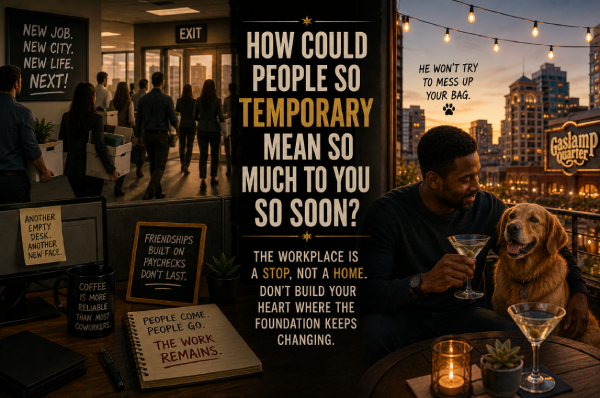
    How could a person so temporary mean so much to you so soon?

    That co-worker at your job could be the fucking devil for all you know. You don’t go to work to make friends. You go to work to get the bag and go home.

    It’s true that under normal circumstances work is not entirely a meritocracy, and that others can vouch for you if they know your character. But these aren’t normal circumstances.

    Have you seen the state of humanity lately?

    People will literally team up to get you fired because you consistently exceed the limits of their expectations, both on and off the clock.

    One such exceeded expectation could be that you just bought a new house. Would they really have known about the house if you guys weren’t hanging out off the clock?

    “But I didn’t mean to tell them about the house! I swear it was only a slip of the tongue!”

    Exactly.

    Your tongue wouldn’t have slipped if you guys weren’t hanging out off the clock so often.

    So you know that famous cliche, “work hard, play harder?”

    Well I am convinced that work hard, play harder was coined by narcissistic, jealous coworkers, and that the so-called “Happy Hour” is them playing harder, which is when they truly thrive.

    So my question once again is how could people so temporary mean so much to you so soon?

    Now look. I get that not everybody still lives in their home town. Neither do I by the way. I also get that not everybody is a natural introvert. It can get lonely sometimes. But if you wanna make friends, talk to your neighbors, or something.

    Get a fucking dog.

    I mean, sure little Fido might piss all over the fucking carpet while you’re gone all day, but even if he doesn’t live past ten human years, you’ll probably still have him much longer than your six month co-workers.

    And the best part of all is that he won’t try to mess up your bag.

    © 2026 The Buckinchere Publication, SP.

    All Rights Reserved.

    Who actually makes better friends than your co-workers when you are in a new town?
  • Blog 113

    Blog 113

    Ready.

    Hypocrisy of the profanity police — What makes a word bad?

    B. Lorenzo Buckinchere

    Jul 5, 2026

    Within polite society, there are some words that are considered good, and other words that are considered bad. Words like “fuck” and “shit” are generally considered bad words, meaning it is impolite and unprofessional to use them in schools, churches, or official broadcasts. These words are called profanity, suggesting that they are profound, but in a negative way, therefore, profane.

    But what actually makes a word “bad?”

    Historically, the medieval hierarchy of English society determined whether a word was good or bad. After the battle of Hastings, the English language became a mix of Anglo-Saxon words, and Norman words.

    Now the Angles and the Saxons were Germanic tribes who settled in England after the collapse of the Western Roman empire during the 5th century CE, while the Normans introduced an earlier version of French which had its roots in Latin.

    And Latin being the language of the Romans was considered far more sophisticated than the language of “savage tribes,” which is why saying “stool” is considered “proper,” while “shit” is considered “profane.”

    England is not the only place where the Normans bastardized the language of entire tribes. They also bastardized the language of native tribes within their homeland, which is why Norman is considered more sophisticated, while Breton is considered superstitious.

    Religion also had a major influence over how certain words within a language were perceived. So did cultural nuances.

    For example, a pinche is a kind of scullery maid. Insulting someone by calling them a servant doesn’t make sense in English. Yet in Spanish, it makes perfect sense. So you might hear a Spanish speaker say, “Muchas trabajo, pinche dinero,” and wonder what the heaven they’re talking about.

    Fast forward to 2026, and the legacy of the Normans has crossed the pond into the Americas. People still believe that saying the wrong word in the wrong setting, or at all for that matter, is inappropriate, and would actually be quick to check you on that, while also calling you stupid at the same time.

    For example, he stubs his toe on the nightstand, “Ah, fuck!!”

    His wife rushes in, “Don’t swear in front of the baby, stupid!”

    So then what’s really bad?

    One word is rooted in the language of he whom long dead conquerors have labelled a savage. The other word actually disparages you. And the word that offends you will expose whether or not you’re a hypocrite.

    So how come words like idiot, and stupid, and slow, and retard aren’t considered profanity? Yet words like shit and fuck are natural acts, literal bodily functions that we all do from time to time that doesn’t, or shouldn’t offend anybody.

    Now if religion had any part to play in influencing how certain language is perceived, then it’s no wonder all the bodily functions keep coming up as the same usual suspects. Because supposedly, sex is bad. And don’t even get me started on the colloquial meanings behind some of the Caribbean’s most notorious expletives.

    Oh, I get it! The next time I stub my toe on the nightstand, I’m totally gonna yell, “Ahh, stupid!!”

    Happy Independence!!

    © 2026 The Buckinchere Publication, SP.

    All Rights Reserved.

    What makes a word bad?
  • Blog 107

    Blog 107

    Ready.

    Buckinchere’s Wager:

    Comfort vs Power in Modern Society

    B. Lorenzo Buckinchere

    May 24, 2026

    Ok, so you’ve heard about Pascal’s wager, right?

    The suggestion of Blaise Pascal that it’s better to suffer for a lifetime here on earth, then finding out that there is no god, than it is to live for yourself here on earth, only to die and find out that there really is a god.

    Well, have you ever heard of Buckinchere’s wager?

    Of course not. Because this is my first time writing it. Well today you’ll learn exactly what that is, and why it’s important.

    Do you know what makes a normie a normie?

    His addiction to ease and comfort. He doesn’t like to think, and he hates anybody who is curious and asks questions. He just likes things to run predictably.

    Now there’s nothing inherently wrong with wanting to maintain a smooth operation. But the normie wants to maintain predictability much to the detriment of progress.

    The truth is that life is not linear. It can get messy sometimes, especially for those who are daring enough to want more than what the lot of their birth dictates, and actually go after it.

    You can say you want something, and not pursue it. But if you have the audacity to actually pursue it, you will learn really fast that society doesn’t like confident go-getters. Because to do so will be you holding up the mirror to Caliban’s hideous deformities, “the rage of Caliban seeing his own face in the glass.”

    It’s even worse if you self-validate and go after your dreams anyway. Then they’ll really try to sabotage your plans as punishment for you not giving them the power to gatekeep your destiny.

    What I’ve just described is the dichotomy of power versus comfort. The normie is not happy, but he is comfortable with mediocrity and predictability. While the neurodivergent on the other hand, is willing to brave the deep, dark waters in search of lasting power and freedom.

    As such, the normie will commute through rush-hour just to get to a wretched, detestable job, just so he can pay the bills. Meanwhile, he’s getting no fulfillment out of his occupation. Plus, he is being underpaid and disrespected.

    The neurodivergent on the other hand, though doubtful, is still brave enough to pursue his creative endeavors until they start paying off. The carpenter may not get paid much, but he receives a sense of fulfillment whenever he is finished working on someone’s coffee table.

    When it comes to dating, the normie may date another normie just so they can split the rent in half, but then they end up hating each other. Then the next thing you know, the girl normie misses her period, and now, they’re stuck raising a kid they weren’t ready for.

    You cannot love a child if you don’t even love each other.

    Meanwhile, the neurodivergent has wilfully chosen to sacrifice the shallow comfort and fake connection of a modern relationship in favor of the power and freedom of being alone. Sure, the neurodivergent would miss sex, but that’s just about all they would miss.

    When it comes to platonic connections (friends and colleagues), this is where the normie truly thrives. Office lunches, happy-hour, football Sundays. He thrives on the hierarchy of winners and losers. Haves versus have nots. Us versus them.

    You get the idea!

    The normie is so disgustingly linear in his thinking, that when a neurodivergent goes off script by choosing solitude and insulation from all the madness of the world, it irritates the normie to no end.

    Because in the midst of his foolish insecurities, the normie feels like you are taking away the single greatest source of his esteem by being an example to others that self-sustainability is very much possible. As if it’s your fault that the normie fool has an external locus of control to begin with.

    As such, the normie, sociopathic as he is, will undoubtedly try to sabotage the neurodivergent just to be able to save his ego and prove a point [more on normie].

    He will “play the long game” and catch more flies with honey than vinegar, so great is their addiction to comfort and familiarity.

    This is what makes them dangerous!!

    And don’t even get me started on family enmeshment. If you come from the bowels of the working class, then your family is full of normies.

    This is not a theory!

    If you want to date a girl they don’t like, or goodness forbid you want to move to a new town, they will be the first to talk you out of it, and give you a million and one reasons as to why they think it won’t work.

    But they’re unhappy, too. What do you mean it won’t work?!

    It’s not that they think it won’t work, it’s that they’re too comfortable being unhappy to seek to make things better. And they were banking on you being jut as fucking lazy as they are.

    But now that you have chosen power over comfort, you have become an inconvenience, and a source of embarrassment for them. Because by so doing, you have held up the mirror to the rage of Caliban seeing his hideous face in the glass.

    Power, on the other hand, can be uncomfortable at first. It can be unfamiliar, unpredictable, and downright chaotic. But if you choose to rise after every obstacle. If you choose to keep showing up for life, every day, then power is definitely worth it in the long run.

    The rest is up to you!

    With that said, I wager to you now, will you choose the fleeting comfort of crap jobs, and shallow relationships. Or will you instead venture out into the deep blue waters in search of total power, freedom, and your ultimate destiny?

    Short-term comfort or long-term power?

    That is my wager.

    © 2026 The Buckinchere Publication, SP.

    All Rights Reserved.
    As it relates to the article, do you choose comfort or power?
  • Blog 105

    Blog 105

    Ready.

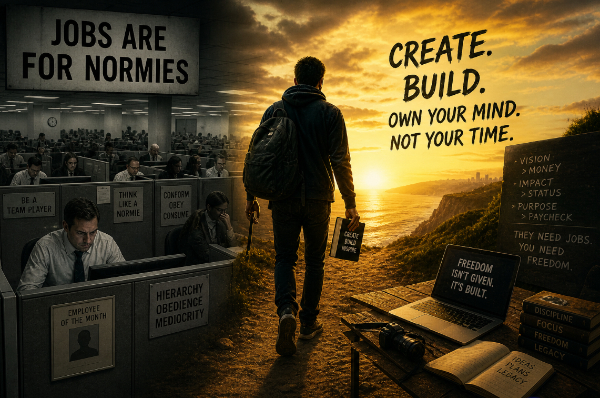
    Jobs are for Normies

    B. Lorenzo Buckinchere

    May 10, 2026

    And that goes for all jobs. White-collar. Blue-collar. Entry level. Professional. And everything in-between.

    It’s just that some normies were able to get into white-collar management positions because they were willing to lie, or sleep their way to the top, screwing others over on their way up.

    Either that, or the lot of their birth had afforded them the privilege to attend college. For those reasons, they are a little higher up on the societal food chain than others.

    But they are still normies for the very simple fact that they are comfortable with playing the hierarchy game while seeking to humiliate those who just want to quietly do their jobs and go home.

    A lot of the people with jobs don’t even need the money. They either have a trust fund, or a wealthy spouse. A job to them is nothing more than a chessboard for power. More on that later.

    If you are inherently creative, then by default, you are not obsessed with hierarchy, because you spend much of your time in your right brain, and creative energy tends to lean more feminine.

    For that reason, you cannot work a normie job. Not for long anyway. Because the opposite of a normie is to be neurodivergent.

    If you are creative, then you have neurodivergence by default, and the moment the normies spot that you are different, they will gang up on you and seek to ostracize you, and it won’t be obvious at first because they will appear friendly.

    But understand that that is the most important part of the facade. You catch more flies with honey than vinegar. By the time you are able to figure out that you don’t belong, it will already be too late, and you won’t be able to fight them so easily.

    And in fact, you don’t belong because you are not supposed to. You see, jobs are for normies.

    The typical. The average. The talentless.

    That’s why they fight to gatekeep their spaces from neurodivergents so ferociously. They figure it’s only fair because they need those spaces to survive, and you don’t.

    You can literally get up one day and decide to write a book, or build a website. They can’t! They need those jobs. And for every job that is occupied by a neurodivergent, that’s just one more job they figured could have gone to one of their normie friends or relatives.

    Not only that, but most blue-collar jobs are service level positions. We’re talking about; uber, Lyft, UPS drivers, Amazon Prime, warehouse associates, telecom tower technicians, etc.

    When neurodivergents create something meaningful and relatable, we need people to help us move it across town right to the doorstep of our paying customers. And that’s where normies come in.

    Why would you want to work among normies when they are literally meant to serve us?

    Sometimes, a shift in perspective is really all you need to help move things along smoothly. So with that, I close by reiterating my main point.

    Jobs are for normies.

    © 2026 The Buckinchere Publication, SP.

    All Rights Reserved.

    Neurodivergents should work a regular 9 to 5 job;

  • A conversation about male elegance

    Ready.
  • Property tax solutions

    Property tax solutions

    Ready.
  • The Lateness of the Hour (Twilight Zone Review)

    The Lateness of the Hour (Twilight Zone Review)

    Ready.

    B. Lorenzo Buckinchere

    Jul 27, 2025

    It is the end of the month, and time once again for our monthly review series here on this blog site. Our muse for the month of July is a classic Twilight Zone episode titled, “The Lateness of the Hour.”

    But before we begin, here is a disclaimer: The following review contains spoilers, so I strongly recommend watching the episode before reading this or any reviews on the topic. Now without further ado, let’s begin.

    The Twilight Zone was an American television primetime anthology series created by Rod Serling. It originally aired on CBS between 1959 and 1964, and ran for five seasons and 156 episodes.

    It was way ahead of its time due to its many themes on existentialism, and for questioning the status quo of the time, particularly as it pertains to power and racial equality, often using extraterrestrial life forms as metaphors.

    The episode in question was episode 8 of season 2, and aired originally on December 2, 1960. Written by Rod Serling, and directed by Jack Smight, it was the first of five episodes that were videotaped on a soundstage due to budget cuts.

    Though still incredibly haunting, the stiff, videotaped picture quality gave the episode more of a “Playhouse 90” or “General Hospital” feel, rather than the usual existential dread that one can expect from a typical Twilight Zone episode.

    The Premise:

    The episode features a young woman named Jana (Inger Stevens), the adult daughter of Dr. William Loren (John Hoyt), and his wife (Irene Tedrow). They live alone in a  large house, and entirely rely on their servants for domestic comfort. One rainy night in particular, Jana begins to question her parents’ dependence on their servants.

    Frustrated, Jana attacks the maid who tumbles down a flight of stairs before getting back up like nothing happened. It was only then that her father revealed that he created his servants to be quite indestructible.

    We then cut to Serling’s opening narration, The residence of Dr. William Loren, which is in reality a menagerie for machines. We’re about to discover that sometimes the product of man’s talent and genius can walk amongst us untouched by the normal ravages of time. These are Dr. Loren’s robots, built to functional as well as artistic perfection. But in a moment Dr. William Loren, wife and daughter will discover that perfection is relative, that even robots have to be paid for, and very shortly will be shown exactly what is the bill.

    The following scene sees Jana with her back turned to her father and his butler, yet is able to accurately lip sync every word of their conversation. The butler forgot to fill Dr. Loren’s pipe, so Jana breaks the nightly routine by offering to fill the pipe herself.

    Jana is jaded with being home with her parents every night, and suggests that they all go out to a restaurant. Her father protests that doing so is a bad idea, because they would get sopping wet in the rain on their way over there. Then they would be served on dirty, unwashed plates dealing with rude, pushy normies. After that, it would be a question of whether they succumb to ptomain, or pneumonia.

    Jana doesn’t seem to mind. She figures, “at least we get to live a little.” Or at least that’s what her attitude implies, to which her father gives her quite the sobering speech, “I have kept you from harm, I’ve protected you against disease, and insulation in this 20th century is no crime, it’s a service. You’ve never had to look into the face of war, or the face of poverty or prejudice. Well you’ve been isolated, yes. But what you think of as imprisonment just happens to be asylum, and security, yes, and survival.”

    Jana still thinks that her parents have become so overly dependent on her father’s android servants, that very soon they won’t be able to survive without them. She threatens to run away from home if her father doesn’t dismantle the androids he built, to which he refuses.

    He can’t just dismantle his life’s work, but at the same time, he loves his daughter, and doesn’t want to lose her. So he pleads with Jana to stay, but she makes another scene by climbing to the top of the stairs and announcing that the androids may be indestructible, but her parents are not.

    In that moment, it seemed like the androids were getting ready to turn on the Lorens, but in the following scene, it turns out that they are ok. Dr. Loren further pleads with Jana to stay, who is adamant that she is leaving, and starts packing her suitcase. So he makes the most rational decision that any father would make under the circumstances, and summons the androids.

    He tells them to meet him in the laboratory, and they all protest, saying what good servants they are, and why he should spare them. But his instructions are clear, his mind is made up.

    In the next scene, Jana is seen happily running around the house, checking all the closets. And when it is obvious that the androids are gone, she hugs her parents and thanks them with love and loyalty.

    She is excited that they can all go out and live like normies now that the androids are gone. But the joy that her parents get from watching Jana be happy for once soon turns to concern the moment she mentions the possibility of marrying and giving them grandchildren. She notices their concern, and asks them what’s wrong, but they excuse it away as shock that she would want to start dating so soon, and she’s not buying it.

    She flips through the family photo album, and realizes that there are no pictures of her as a child, only of the robots, some of the photos were from twenty years ago. Her father asks her if she remembers her childhood, and she surmises that she was implanted with a memory track, similar to what Dr. Loren gave his android servants.

    Dr. Loren explains to Jana that both he and Mrs. Loren were a childless couple, and that was when they “got her.” Realizing that she was made and not born, Jana runs up the stairs and bangs her wrist against the staircase railing, but is unable to feel anything, not even love. Her parents try to console her, but she is devastated to learn that her dream of having a family is ruined due to the fact that she is also an android. Her mother asks her father what to do, and he has an idea.

    In the final scene, it is revealed that Dr. Loren reprogrammed Jana to be a maid, and she is seen giving her mother a shoulder rub.

    Then we cut to Serling’s closing narration, “Let this be the postscript. Should you be worn out by the rigors of competing in a very competitive world. If you’re distraught from having to share your existence with the noises and neuroses of the 20th century. If you crave serenity, but want it full time, and with no strings attached. Get yourself a workroom in the basement, and then drop a note to Dr. and Mrs. William Loren. They’re a childless couple who made comfort a life’s work. And maybe there are a few do it yourself pamphlets still available in The Twilight Zone.”

    Takeaway:

    This particular postscript pretty much sums up the secret fantasy of every reclusive type who is forced to grind away in a hyper competitive world. This episode was way ahead of its time, and is even more relevant today than it was when it first premiered on television over 60 years ago.

    I first saw this episode about 20 years ago, during a time when I was still living in Jamaica, going through high school, and barely younger than Jana was in that episode. I thought that android maids was a cool new concept, and as such it was fun to watch at the time. But it wasn’t anywhere near as relatable to me then, as it is now. In the space of twenty years my perspective has shifted from the naivety of a sheltered brat like Jana, to the wisdom and experience of her father.

    The scene where he told her that she has never had to look into the face of poverty, prejudice or famine suggests to me that the Lorens could have lived through the great depression, or the holocaust.

    Judging by the age of the actor John Hoyt (1905-1991), he was likely among the allied forces who stormed the beaches of Normandy in 1944, which means that he stared directly into the face of war and bloodshed. Then he looked away and never looked back.

    Jana doesn’t know the ways of the world so she believes that everyone is the same. “Who feels it, knows it,” so how can one appreciate serenity away from all the noise if they have never felt the noise?

    Conclusion:

    John Hoyt is my new favorite person just for that speech that Dr. Loren gave to Jana during the episode. Rewatching this episode in the present has given me a fresh new perspective, and has only served to reinforce my commitment to an introverted, reclusive life.

    Imagine a life where liberty, security, and securities are the order of the day. Well I am of the firm belief that you are more likely to thrive as an introvert than you would in friendship groups. I give this one a solid five out of five android maids, and I’ll see you on the next one.

    © Copyright 2025 The Buckinchere Publication, SP.

    All Rights Reserved.

  • Reclaiming our crown — Soft Life for Black Men

    Ready.

    B. Lorenzo Buckinchere

    Apr 20, 2025

    The #SoftLife movement is taking over the world by storm. Whenever people think about someone living a soft life, they picture a white woman, or even a black woman for that matter.

    The specific stereotype is usually that of an ultra feminine white woman who inherited all her wealth from daddy, or an educated black woman who earned her wealth at some point after escaping an abusive upbringing full of hard knocks, and now she can travel the world on her own time and dine in style on her own dime.

    Those stereotypes are harmful in and of themselves because not only do they reduce the individual down to solely their race, but they also discount everybody else having a similar experience. As harmful as those stereotypes are, none of them are quite as harmful as the racist belief that black men are just not meant to live a soft life.

    The reason why that view is racist is because it limits the black man solely to a life of servitude to everybody else besides himself, and that judgement is based on no other reason besides his race and gender, and with zero consideration as to what he has to say about it.

    The world is of the insanely rigid view that their comfort and convenience should be achieved on the backs of black men. They dread the day that they will be forced to share their privilege with us, and will defend that status quo with their lives.

    They also have an idea of how a black man ought to behave based on negative stereotypes in the media that harms us rather than help us to progress.

    Negative stereotypes such as the tatted up black thug in the projects, the pornographic stereotype of the BBC, or a more archaic stereotype of the fat, greasy, blue-collar worker who is always caught sleeping on the job and eating watermelons all day, and they expect us to keep perpetuating that stereotype for their own benefit.

    So when they discover otherwise upon meeting you, they try to discourage your grace and elegance, first by acting like you are lame or awkward for being that way, before ultimately seeking to destroy you for it.

    At the same time, they expect you to pedestalize and entertain them at work all day. That is why it infuriates them internally when all you want is to be left alone to perform an honest day’s work, get paid and go home.

    That is not something I would ever consent to in my right mind, simply because I am nobody’s dancing monkey. And not only that, but it also rudely interrupts the plans I have for my own life, which is to live as soft a life as is possible on this prison planet until I croak.

    Life is too short, and we are here for a good time, not a long time. So if living a soft life as a black man in America somehow makes me selfish, so be it. After all that I have been through in my own lifetime alone, the least you can do is stay out the fucking way and allow me the space and mental bandwith to eke out my own path. No one said you had to like me.

    The first step towards living a soft life as a black man is to remain cognizant of the fact that these racist motherfuckers are not your friends, they expect you to amuse them. If you let people get inside your head, it could cost you your life.

    Secondly, stop working for these racist corporations who want to silently murder you with poverty and overwork. With poverty and overwork comes stress, with stress comes illness, and with illness comes the greater likelihood of ending up in an early grave.

    Thirdly, everybody on the planet was born with a unique gift, whether or not they choose to answer the call. Do some soul searching to discover your own unique gift, and then monetize it. The last thing they want is for the black man in America to buy his own house and start his own business. Well I say give ‘em hell, it literally keeps them up at night. Take your revenge.

    Fourthly, when you are no longer under socio-economic stress all the time, threats against you may become more legal, perhaps even criminal. Tread carefully on the surface of this planet, remain ever vigilant and keep a low profile at all times, which brings me to my fifth point.

    Stay away from troubled people, and most important of all, make sure that they stay away from you, too. If you are a strong, intelligent and elegant black man like I am, you do not fit with the proletariat of society, or who we call normies here on this blog site.

    They are a classless bunch of weirdos with bad manners and bad hygiene, compared to you who is the male equivalent of a triple threat. Be careful of the bars, clubs and restaurants that you frequent. Be careful of the kind of women you choose to date.

    The normies will gain access to you at these venues, and through some of these women if they can no longer gain access to you at work. Same as how threats against you will become more legal when they can no longer get you fired. But then again your tastes should evolve as you become more of a hedonistic connoisseur.

    There is a reason why celebrities walk with an entourage, or why a presidential caravan doesn’t reveal which one of the cars the president is riding in. I’m not saying that you should do the same, but when you start frequenting more high class establishments, the normies won’t be able to reach you then, because they simply cannot afford it.

    Speaking of women, many male celebrities end up becoming shrouded in scandal because they cannot control where they stick their dicks. From Cosby to Kelly to Bryant, the scandals keep coming, and have been proven rather harmful to their reputation.

    Whether or not the accused is actually guilty of the allegations doesn’t change the fact that their names would have never been called if they did not go there to begin with.

    There is only a certain caliber of woman whom you can safely sleep with going forward. Pretty little normies are only there for the money and attention. Where the hell were they on your absolute worst days when you were getting it out the mud, and didn’t much feel like being alive?

    Finally, do some more soul searching, but more so as it relates to your tastes and preferences this time. The first step in doing so is to remember when you were daydreaming as a kid about your adult life in the future.

    What were the details of some of those fantasies and how can you tweak it to make it work in the world as you now understand it? Your fantasies were not complete back then. There were many missing details because your imagination wasn’t fully developed.

    You must now decide for yourself if there is anything you would add to, or subtract from your fantasy now compared to before, and then make your dreams a reality. Your inner child is starving for his dreams to be validated, and it’s time you stop ignoring him for the sake of other people’s egos and expectations, for you too are worthy.

    Soft life is not exclusive to any single group. It is the reward for making all the right decisions within a market as capitalistic as the American economy.

    © Copyright 2025 The Buckinchere Publication, SP.

    All rights reserved.

  • The power of solitude

    Ready.

    B. Lorenzo Buckinchere

    Mar 16, 2025

    If a plane goes even 1 mile outside of its designated parameter, it’s far off course, and it’s hard to get back on. The same is true for friend groups that’s wrong for you, or even family for that matter.

    Two’s company and three’s a crowd. A wise man once told me that if you give the devil a ride, he’s going to want to drive.

    Say for instance, you were born into a family of attorneys. Your father is a lawyer, your grandfather is a lawyer, and his father before him was a lawyer. For the entirety of your life so far, you have been told that you must follow in their footsteps. You go along to get along even though you have always wanted to be a singer.

    Legal papers may bore you, but music is your passion. If you don’t break free from among them and take a plunge into the deep blue waters to do some soul searching and seek truth, you will go on believing that law is your passion.

    This would have been most unfortunate because not only have you missed your true calling, but doing so has caused a ripple effect that led to a brain drain in your preferred industry. You could have been the single greatest vocalist of all time. But now, you have allowed someone less deserving to steal your destiny because you think you’re supposed to be an attorney.

    Likewise, over on the wrong side of the tracks, you always wanted to be an attorney. You tell your family and some of your neighbors out of naivety, hoping they would encourage you. Not only do they not support you, but they actually call you a divestor because they all collectively have a crab in a bucket mentality.

    In order for you to get along, you foolishly turn down a scholarship to study abroad just so you can fit the mold for society’s expectation of you. Five years later, you are now a single mother of four with no man in the damn house, flipping burgers for a living. All your old school mates are living the dream, while you can’t even find the time to pick up a book after work.

    Not only do you not know who you are, but the legal profession has also suffered a brain drain. You could have been the most legendary attorney of all time, but now an innocent man being railroaded by the system will lose his case and get sent to the chair because you missed your calling. That condemned man could have gone on to father a son who would’ve found the cure for cancer, but that will never happen now either, and on and on it goes.

    It also doesn’t help that it’s difficult to break out of certain mental conditioning. Once you’re off course, it’s hard to get back on, and it usually takes something truly drastic taking place in your life in order to snap you out of it.

    But before that drastic thing happens, you can choose to take a plunge into the deep blue waters and do some soul searching. What does that look like? It could look like many things, but whatever shape it assumes, solitude is definitely at its core.

    When you shut out the useless noise and clutter, your brain starts talking, and when your brain finally shuts up, your heart starts talking. That’s usually when you remember what you wanted to do when you were fourteen, and still living at home with no responsibilities.

    Solitude can be brutal, especially if you are an extravert, but even if you are not. It is when you are truly alone with no distractions that all the mistakes of your life will flash before your eyes. But it is also when you will discover who you really are.

    Before that, you were seeing yourself through the lens of other people’s perceptions of you, but those perceptions are skewed based on their own biases and subjectivities. If you want to get an unbiased, objective perspective of yourself, you must be willing to enter your isolation arc.

    Not only should you be willing, but also prepared to face whatever you will discover, because all of your life choices and mistakes might hit you like a ton of bricks. It could get pretty intense. You are not going to have any support, you will only have yourself.

    If you are looking for some kind of higher power to be there for you to lean on in those moments, maybe you’re not ready for this. Your isolation arc might even reveal that the higher power in question is not really what you thought it was, but that topic deserves its own article. The bottom line is that the isolation arc is going to screw you raw with no lube, there is no buffer for this.

    But once you are done, your covert enemies will be exposed for what they truly are, and it will then become clear to you exactly why they are your enemies. Most importantly, you will never make another decision out of fear, which means that no one will ever be able to manipulate you. After that, you will essentially become a whole new person, and your trajectory for the future will be back on course. It’s going to be a beautiful day.

    © Copyright 2025 The Buckinchere Publication, SP.

    All rights reserved

  • A post-modern take on Maslow’s Hierarchy

    Ready.

    B. Lorenzo Buckinchere

    Feb 9, 2025

    As a human being, one will experience different needs at different times of life. It is a part of being alive, and you will have these needs as long as you remain living. There are different needs that will arise at different times of your life, based on your current story arc. Some needs are more basic than others, such as food, warmth and water. The more basic the need, the more likely it is to be repetitive.

    Of all the philosophers to explore the nuances of the human condition, none has come close to breaking down the hierarchy of needs quite like Abraham Maslow, an American psychologist of Russian-jewish heritage who lived between 1908 and 1970.

    Maslow first proposed the hierarchy of needs in his 1943 paper, “A Theory on Human Motivation,” where he listed a five tier structure containing a group of human needs in ascending order, suggesting that the fulfillment of one need would motivate an individual to tackle the following need on the chain.

    Maslow’s hierarchy is controversial, and contains some inconsistencies. Due to its hierarchical structure, many are of the few that the order of each need must remain intact, as one is not able, or should not be able to skip levels. But in spite of its imperfections, Maslow’s hierarchy is nonetheless the most frequently referenced hierarchy as it pertains to human growth and motivation.

    On the first tier, there are physiological needs, which include; breathing, food, water, warmth, clothing and sex. On the second tier, there are safety needs, such as; money, housing and transportation. On the third tier, there are social needs, such as; family, friends, sexual intimacy and a sense of community belonging.

    On the fourth tier, there are needs of esteem, such as graduating from college, releasing an album, publishing a book, or getting married. Then there is the fifth tier on the hierarchy, a need for self-actualization.

    Maslow may have structured his hierarchy with the best intentions in mind, however, there are some inconsistencies relating to the order of achievement. For example, except for breathing, one typically doesn’t expect for physiological fulfillment to be freely given unless one is a child, or disabled.

    Even with adult disabilities, one would have to be lucky enough to live in a country with a good welfare program, or else be left for dead. However, that is the exception. For the most part, you need a job in order to buy food. But in order to gain employment and maintain it, one needs to be liked and accepted by the group, or else they will either be used and discarded, or flat out rejected right off the bat.

    Social acceptance comes from level three on the hierarchy, so therefore, based on that reason alone, it seems as though one should gain social acceptance first in order to survive.

    Social acceptance is usually rooted in childhood connections that would have otherwise lasted a lifetime. But what if you constantly relocated throughout your childhood? Or what if you are just socially awkward? What if you are just an introvert?

    Centuries ago, or in fact, even as recent as the 1980s, you would be left for dead without social support. Conformity is primordially ingrained deep within our collective subconscious, that is why all normies would rather conform to society than embrace their true nature.

    Luckily today, with the advent of the internet, you can literally create something that adds value to the lives of others, and pay someone who is naturally more socially outgoing to market it for you. If you find that you are naturally an introvert, I recommend becoming an author and enjoying the benefits of faceless fame, the best of both worlds.

    However, creating something that adds esteem is found at level four of the hierarchy. One may choose to approach the hierarchy based on one’s own tastes and interests.

    For example, an extravert seeking employment may prioritize social conformity, even to the detriment of morality, while an introvert may choose to prioritize esteem. Another cause for concern is being able to secure food with no safe place to leave it, or no transport to even procure it.

    So here is my revised version of Maslow’s hierarchy as it relates to modern life. Particularly as it relates to eccentric introverts, because my blog is not for normies.

    First of all, make safety a priority. Once you are safe, do some soul searching with the intent of discovering your niche. This requires long, lonely periods of isolation from the world. My advice to set you up on the right path for rediscovering your niche is to remember what you loved to do when you were 18.

    It also helps if you keep in mind that you will naturally be good at whatever it is that you enjoy doing. That niche will provide esteem while also providing for all of your physiological and safety needs.

    Once you have rediscovered your niche and you are dedicated to your purpose, you will find that the right social support naturally forms around you. Others with whom you share a common interest will naturally gravitate towards you as they too become inspired.

    So once again to recap, safety first, then esteem, then physical needs, then social support. Self-actualization can only be achieved by becoming exceptionally good at performing your niche, the very best. And that can only be achieved through many decades of consistently showing up and honing your craft.

    © Copyright 2025 The Buckinchere Publication, SP.

    All rights reserved