Tag: The Buckinchere Transcendence

  • Blog 116

    Blog 116

    Ready.

    Review of The Harder They Come

    B. Lorenzo Buckinchere

    Jul 26, 2026

    It’s the end of the month, and time once again for our monthly review series. Our muse for the month of July is Ivanhoe Martin from The Harder They Come.

    But before we begin, here’s a disclaimer.

    Disclaimer:

    The following review contains spoilers, and is subject to interpretations that may not express the perspectives, or intentions of the creators. Please watch the film in its entirety before reading this, or any other reviews on the topic.

    Now without further ado, let’s begin.

    Overview:

    The Harder They Come is a 1972 Jamaican crime film co-written by Trevor Rhone and Perry Henzell, produced by International Films Management, Ltd.

    It is loosely based on the life of 1940s Jamaican criminal, Vincent “Ivanhoe” Martin (better known as Rhyging), and stars legendary reggae singer, Jimmy Cliff.

    Plot:

    In 1972, Ivanhoe “Ivan” Martin (Jimmy Cliff) was a typical country-come-to-town youth of that era. As soon as he arrived in Kingston, he was tricked by a random hardcart vendor, played by Volier “Maffy” Johnson.

    He asked around and soon found out where his mother (played by Lucia White) resided, and went to visit her. He told her that her mother died and sold the house, and gave her what remained of the money.

    Right from the jump, her attitude towards him was very neglectful, and she told him he cannot stay with her in Kingston, so he should go back to rural Jamaica. But Ivan was determined to make it big as a singer in Kingston, so his mother gave him the number for a local preacher (played by Basil Keane).

    With nowhere else to spend his first night in town, Ivan went to see a show with some of the guys in the tenement yard where his mother had resided. It was a western, and some of the movie patrons were seen jeering and yelling at the screen, “hero no dead till the end.”

    Over the next few days, Ivan, who was essentially homeless and sleeping at bus stops, asked around for several odd jobs, but was rejected on every occasion.

    Eventually, the preacher gave him a car repair job in a nearby junkyard, and it wasn’t long before Ivan wooed the preacher’s daughter, Elsa (Janet Bartley). But there was trouble.

    One of the other men who worked in the junkyard would always disparage Ivan, but he pushed it too far when he stole Ivan’s bicycle.

    Ivan used a knife to slice up his co-worker’s face in a fit of rage, showing his first propensity towards violence, at only 30 minutes into the film. The judge sentenced him to be publicly lashed with a tangerine whip, and he was lashed until he ended up peeing on himself.

    Then there was a “Mr. BigStuff” type record producer in town named Hilton (Bob Charlton), and Ivan had the opportunity to audition for him when the preacher sent him to deliver a record.

    He performed an earlier rendition of the Harder They Come, but he didn’t quite make the cut. So he asked Elsa if she could lend him the key to her father’s church, so he and some friends could practice after dark.

    Elsa was rather apprehensive about lending Ivan the keys for fear of betraying her father, but Ivan told her that she was a grown woman, and that she had to choose between him and the preacher.

    Elsa ended up lending him the keys, but they were soon caught by the preacher who got upset and threatened to call the police until Ivan’s friend, Jose (Carl Bradshaw), mentioned that they had a key. He went straight to Elsa whose confession was as bold as it was immediate, and he slapped her, which caused her to run away with Ivan.

    Ivan perfected his single and it became a hit, but Hilton was only willing to pay him JMD $20 (JMD $1000 in 2026). Knowing his worth, Ivan refused and wanted to branch out as his own producer, but Hilton controlled the market, and no one would buy any records, or play the song on air unless Hilton gave the word. So Ivan was forced to sell his song for a measly $20, which he did, believing the popularity of his first hit would lead to other songs.

    He invited Elsa to a party, but she didn’t even have enough to buy food after a long day of job hunting. Ivan lost his patience with her and told her that her father had indoctrinated her into accepting that her slice of the pie was waiting for her in the sky when she died, but he wants his share now on earth.

    Then he left and attended the dance without her.

    Then there were a couple of drug smugglers on the music scene, and before long, Ivan, the quiet country-come-to-town youth, got caught up in a life of crime. Before he knew it, he was delivering packages to ganja smugglers in private planes.

    After one of them got caught in Miami, Ivan read in the newspaper that over $100,000 was seized, and decided he wanted a bigger cut. After a while, he started asking too many questions, which led to him being labeled a “troublemaker,” so they decided to “teach him a lesson.”

    Before long the police officer who once turned a blind eye to him riding his bike was suddenly chasing him. Remembering the humiliation from peeing on himself while being publicly whipped, he pulled out a gun and shot the officer off his bike.

    Ivan became a fugitive after he gunned down three more police officers during a raid on his home later that night as he copulated with his wife. He soon gained a lot of respect in the community after he chased the double-crossing police informant out of town, firing shots after him while all the locals gathered around him atop a bridge. Some of the locals soon started hiding him from the police.

    Jose told him about a plan to smuggle him off to Cuba, but Elsa tipped off the police about the plan, as well as where they’d planned to meet. Both Jose and the police were headed to Ivan’s whereabouts.

    Across the Kingston Harbour, over by the Palisadoes, Ivan was laying low, hiding out in the bushes when he spotted his boat. He swam out towards the boat, and they tossed down the ladder and told him to climb. But they soon spotted the police and sailed away, leaving him behind.

    He swam back to shore and the police soon docked ashore, and began their guerilla raid on the sandspit. Hiding in the bushes, he spotted them first.

    He was armed.

    Then they spotted him.

    They too were armed.

    He engaged in a shootout with the police while the jeering of the audience at the show from his first night in town came back to mind, “hero no dead till the end.”

    Outmanned and outgunned by the police, Ivanhoe Martin, the country-come-to-town youth who came hard from the bowels of desolation and desperation to becoming one of the single most notorious criminals of his time, ended up falling hard in the end.

    Review:

    I feel like Ivan never really had a chance to begin with. Too many forces were against him. From his neglectful mother, to a corrupt record producer, and all the working parts in between, he was destined to turn to a life of crime if he wanted his share on earth.

    There is also something to be said about human nature and their innate fear of you doing better than them often leading to betrayal.

    In the end, it was his woman who tipped off the police, and if people have not evolved past their base-level drive, then you can expect that they would turn against you when they notice that you are becoming too powerful within your own right, even if it’s not in their lane.

    Keeping in mind that this film is well over fifty years old, and considering his time and place, I believed that Ivan would have stood a better chance if he’d lived today, than he did back then.

    What, with the advent of AI and VPN? Every nook and cranny of modern Jamaica now has wi-fi. It would then be up to him to figure out the rest.

    Trivia:

    This crime picture was Jamaica’s very first feature film, and was also a musical. It featured some of Cliff’s most famous songs, including; You can get it if you really want, Many rivers to cross, as well as the titular, The Harder They Come.

    It also featured songs by other artists, such as; 007 (Shanty Town) by Desmond Dekker.

    The house wife at the beginning who asked her children “who left the gate open” was played by Beverley Anderson-Manley who was then the First Lady of Jamaica.

    Manley went on to co-hosting the Breakfast Club with Anthony Abrahams on KLAS FM 89 during the 1990s. They hosted the Breakfast Club each weekday morning at the Jamaica Pegasus Hotel in Kingston because KLAS was in Mandeville.

    The radio announcer playing The Harder They Come when it became a hit was none other than legendary broadcaster Don Topping. Topping has enjoyed a lengthy career in broadcast spanning decades. He, along with other radio greats such as Marie Garth, and the late Alan Magnus, is a part of the fabric of the golden years of Jamaican broadcast.

    The Cuban smugglers flying planeloads of drugs to Miami must have inspired the late actor Munair Zacca in his portrayal of Sonny T on the hit 1990s Jamaican soap opera, Royal Palm Estate, though R.P.E. itself is loosely based on Children of Babylon (1980) by Lennie Little-White.

    The Harder They Come was hosted by Professor Mychal Odom at the San Diego Public Library on February 17, 2026 as part of Black history month.

    It was the first time I ever saw it, and it gave me a little slice of home all the way in California. A proud moment indeed.

    This coming Thursday on July 30th would have been Jimmy Cliff’s 82nd birthday. Cliff was born James Chambers on July 30, 1944, and died November 24, 2025, aged 81.

    Verdict:

    This picture was well received at the time of its release, and is every bit as relevant today as it was back in 1972. I give this one a five out of five repaired bicycles, and I’ll see you on the next one.

    © 2026 The Buckinchere Publication, SP.

    All Rights Reserved.
    In the context of Jimmy Cliff's The Harder They Come, do you believe that Ivan Martin was a product of his time and place?
  • Blog 115

    Blog 115

    Ready.

    Keeping up with the idiots

    B. Lorenzo Buckinchere

    Jul 19, 2026

    Ever heard of luxury poverty?

    The act of appearing wealthier, or otherwise more important than others through materialistic possessions, and a false sense of comfort, versus having real power?

    Except that before I’d issued the Buckinchere Wager, people were referring to it as peacocking.

    If you go to a place, such as NYC’s Times Square, or LA’s Hollywood and Highland on a Saturday night, you will see normies out and about, seeking attention by appearing rich for a night.

    That is what is known as peacocking.

    Every city in all the history of mankind has its designated peacock zone. Whether it was the brothels of ancient Corinth, or Athens, or the club scene of every modern city in the world, peacocking is one of the most active moving parts of the social game, and is really just one giant dick measuring contest.

    Both genders practice peacocking.

    Male weapons of choice include, but are not limited to; cars, women, motorcycles, money, clothes, chains, etc.

    Female weapons of choice include, but are not limited to; shoes, cosmetics, purses, the male gaze, or male attention. Cars and money are secondary.

    Peacocking is particularly unwise, because egos tend to flare in those situations, and booze and sex is like dousing the flames with gasoline. In some countries such as Brazil and Colombia, where masculinity can be truly toxic, peacocking is dangerous enough to get you killed.

    Peacocking is mostly intra-gendered, but it can also be inter-gendered. It can occur among couples, and within friend groups.

    Speaking of friend groups, peacocking, though highly concentrated in certain city zones, is not confined to them.

    Peacocking can take place in the PTA at your son’s school, or in your HOA.

    Enter Karen.

    But you wanna know where peacocking is notorious for taking place the most?

    At work!

    The workplace is a marketplace where people go to compete with each other for resources, and measure their self-worth with the resources that they were able to gather, compared to what others in the workplace have.

    The competition is so intense, that they will literally set you up to get fired for simply buying a car.

    Jealous co-workers be like, “We’ll see how much you like your new car once you end up living in it.”

    Whether you work white-collar or blue-collar, the workplace is a melting pot of people from all different backgrounds, and different mindsets who are performing neuro-typicality for a paycheck.

    The culture becomes toxic when you have egos flaring due to a cocktail of insecure people competing for resources, and everybody wants to be the “It” factor. That’s usually when management starts picking favorites, and punishing the hard worker who simply does their job and goes home.

    And as if that wasn’t enough, the peacocking game doesn’t end when you clock out of your shift at 5 O’ clock.

    As soon as you walk in the door when you get home, your wife tells you, “we’re having dinner over at the Joneses tonight.”

    And you’re like, “Again? We just had dinner with them last week.”

    Your wife insists, and threatens to have you sleeping in the dog house again, when all you want to do is kick back with a beer and watch the game.

    You already know that dinner at the Joneses will be nothing more than a massive ego fest about the new car they just bought, or about Mrs. Jones’s new purse.

    What follows next is an existential crisis. You start looking back on your life, and re-assessing your life choices.

    Is the suburban home in the HOA, and the job status, and the car really worth playing this stupid dick measuring contest and keeping up with the Joneses? Would you have actually been happier living as a minimalist in a one-bedroom?

    You never asked for much. All you ever really wanted was health and financial stability. Perhaps to hang out with your buddies, playing acoustics in your garage at 2 AM.

    You look in the mirror, and you notice that you’re not getting any younger. It was only yesterday you were playing soccer with some of the neighborhood kids.

    But now, you notice a bald spot, and another existential crisis kicks in, the undefeatable biological clock we all must face.

    Then you see one of your co-workers, a younger man who is so happy with so little, and… you hate him.

    “Who does he think he is?!”

    Before you know it, you are joining the others in setting him up.

    You have become the very villain you despise!

    You have it all, yet you’ve never been unhappier because it’s still not enough.

    But what did you really expect?

    After all, it was just a stupid game of peacocking. You chose to play the social game when you should have been playing the power game instead.

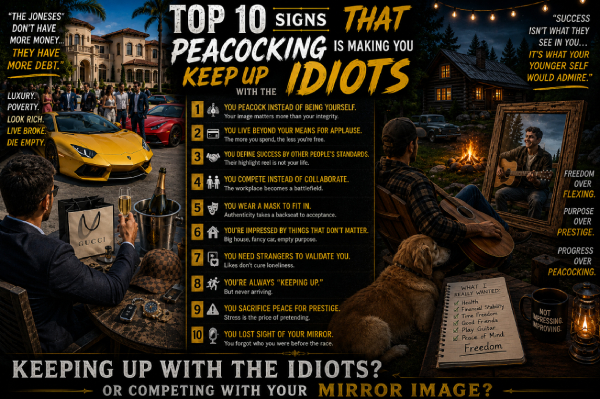
    Remember, peacocking is really just the act of reinforcing luxury poverty by going into debt to purchase things you don’t need to impress people who don’t care.

    Some of these people are deeply flawed. Almost all of them wish they were in your shoes. Yet here you are feeling inadequate without their approval.

    But power has many forms after all. Including the power of freedom and peace of mind.

    So what do you ultimately choose?

    Keeping up with the idiots? Or competing with your mirror image?

    © 2026 The Buckinchere Publication, SP.

    All Rights Reserved.
    I would much rather purchase things because they make me:
  • Blog 114

    Blog 114

    Ready.

    Turnover Friendship??

    B. Lorenzo Buckinchere

    Jul 12, 2026

    Your co-workers are not your friends.

    If you still don’t know that in 2026, then you have been living under a rock your whole life.

    We know that the primary reason for that being the case is that corporate culture is full of cutthroat tendencies.

    One day, they really like you. The next day, they are teaming up to get you fired.

    But here’s something you haven’t considered about why you have no friends in the workplace.

    The turnover rate is too high.

    Think about it. If it wasn’t for that job, you would have never met any of those people. You don’t get to choose your co-workers any more than you are able to choose your family, or your classmates. But unlike your family, where will your co-workers be six months from now, let alone two years?

    Where will you be six months from now?

    Not where you see yourself in six months, but where you will actually end up. Even classmates are more predictable, at least till the end of the semester.

    And don’t even get me started on your army buddies. That situation is way more chaotic and unpredictable than some corporate office back home. You’re lucky if they get dispatched to another base, or get discharged from duty.

    But what if they come back home in a casket?

    What if they make it back home, but they’re merely a shell of their former selves?

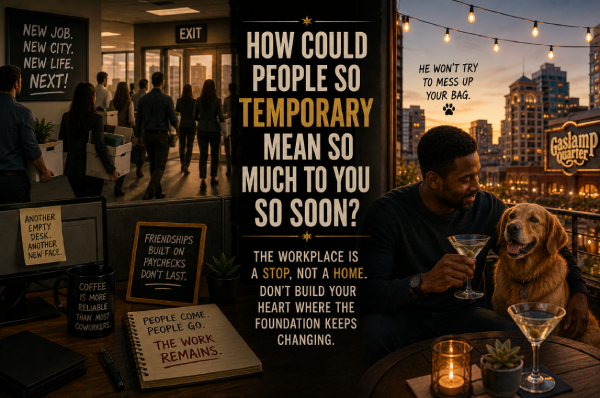
    How could a person so temporary mean so much to you so soon?

    That co-worker at your job could be the fucking devil for all you know. You don’t go to work to make friends. You go to work to get the bag and go home.

    It’s true that under normal circumstances work is not entirely a meritocracy, and that others can vouch for you if they know your character. But these aren’t normal circumstances.

    Have you seen the state of humanity lately?

    People will literally team up to get you fired because you consistently exceed the limits of their expectations, both on and off the clock.

    One such exceeded expectation could be that you just bought a new house. Would they really have known about the house if you guys weren’t hanging out off the clock?

    “But I didn’t mean to tell them about the house! I swear it was only a slip of the tongue!”

    Exactly.

    Your tongue wouldn’t have slipped if you guys weren’t hanging out off the clock so often.

    So you know that famous cliche, “work hard, play harder?”

    Well I am convinced that work hard, play harder was coined by narcissistic, jealous coworkers, and that the so-called “Happy Hour” is them playing harder, which is when they truly thrive.

    So my question once again is how could people so temporary mean so much to you so soon?

    Now look. I get that not everybody still lives in their home town. Neither do I by the way. I also get that not everybody is a natural introvert. It can get lonely sometimes. But if you wanna make friends, talk to your neighbors, or something.

    Get a fucking dog.

    I mean, sure little Fido might piss all over the fucking carpet while you’re gone all day, but even if he doesn’t live past ten human years, you’ll probably still have him much longer than your six month co-workers.

    And the best part of all is that he won’t try to mess up your bag.

    © 2026 The Buckinchere Publication, SP.

    All Rights Reserved.

    Who actually makes better friends than your co-workers when you are in a new town?
  • Blog 113

    Blog 113

    Ready.

    Hypocrisy of the profanity police — What makes a word bad?

    B. Lorenzo Buckinchere

    Jul 5, 2026

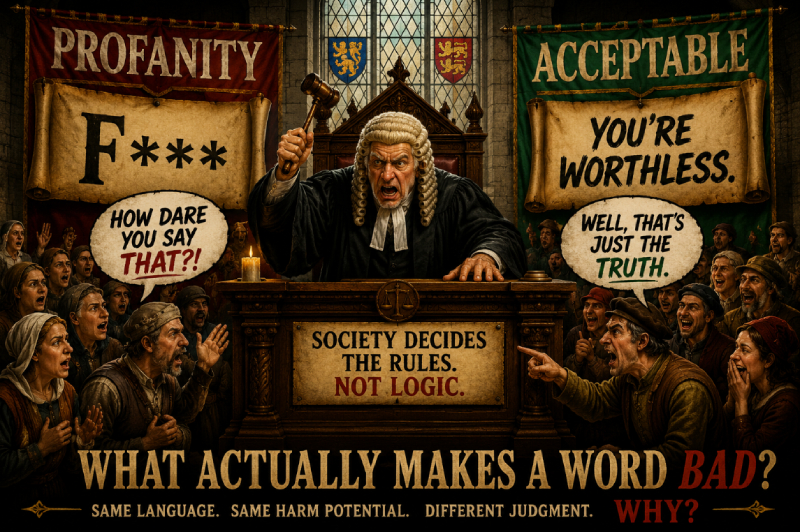
    Within polite society, there are some words that are considered good, and other words that are considered bad. Words like “fuck” and “shit” are generally considered bad words, meaning it is impolite and unprofessional to use them in schools, churches, or official broadcasts. These words are called profanity, suggesting that they are profound, but in a negative way, therefore, profane.

    But what actually makes a word “bad?”

    Historically, the medieval hierarchy of English society determined whether a word was good or bad. After the battle of Hastings, the English language became a mix of Anglo-Saxon words, and Norman words.

    Now the Angles and the Saxons were Germanic tribes who settled in England after the collapse of the Western Roman empire during the 5th century CE, while the Normans introduced an earlier version of French which had its roots in Latin.

    And Latin being the language of the Romans was considered far more sophisticated than the language of “savage tribes,” which is why saying “stool” is considered “proper,” while “shit” is considered “profane.”

    England is not the only place where the Normans bastardized the language of entire tribes. They also bastardized the language of native tribes within their homeland, which is why Norman is considered more sophisticated, while Breton is considered superstitious.

    Religion also had a major influence over how certain words within a language were perceived. So did cultural nuances.

    For example, a pinche is a kind of scullery maid. Insulting someone by calling them a servant doesn’t make sense in English. Yet in Spanish, it makes perfect sense. So you might hear a Spanish speaker say, “Muchas trabajo, pinche dinero,” and wonder what the heaven they’re talking about.

    Fast forward to 2026, and the legacy of the Normans has crossed the pond into the Americas. People still believe that saying the wrong word in the wrong setting, or at all for that matter, is inappropriate, and would actually be quick to check you on that, while also calling you stupid at the same time.

    For example, he stubs his toe on the nightstand, “Ah, fuck!!”

    His wife rushes in, “Don’t swear in front of the baby, stupid!”

    So then what’s really bad?

    One word is rooted in the language of he whom long dead conquerors have labelled a savage. The other word actually disparages you. And the word that offends you will expose whether or not you’re a hypocrite.

    So how come words like idiot, and stupid, and slow, and retard aren’t considered profanity? Yet words like shit and fuck are natural acts, literal bodily functions that we all do from time to time that doesn’t, or shouldn’t offend anybody.

    Now if religion had any part to play in influencing how certain language is perceived, then it’s no wonder all the bodily functions keep coming up as the same usual suspects. Because supposedly, sex is bad. And don’t even get me started on the colloquial meanings behind some of the Caribbean’s most notorious expletives.

    Oh, I get it! The next time I stub my toe on the nightstand, I’m totally gonna yell, “Ahh, stupid!!”

    Happy Independence!!

    © 2026 The Buckinchere Publication, SP.

    All Rights Reserved.

    What makes a word bad?
  • Blog 112

    Blog 112

    Ready.

    Review of — The Pen Was Always In Your Hand

    B. Lorenzo Buckinchere

    Jun 28, 2026

    It’s the end of the month, and time once again for our monthly review series. Our muse for the month of June is Maria Rose.

    But before we begin, here is a disclaimer.

    Disclaimer:

    The following review contains spoilers, and is subject to interpretations that may not express the perspectives or intentions of the author. Please read the book in full before reading this, or any other review on the topic.

    Without further ado, let’s begin.

    Overview:

    The pen was always in your hand is a 2024 American memoir by author and screenwriter, Maria Rose. Published by Pure Dreams Productions, LLC., Maria’s memoir is a faith-based chronicle of her personal struggle from overcoming personal obstacles in her life to discovering her niche for writing.

    Plot:

    In 2010, a 20 year-old Maria had recently taken her toddler daughters, Minerva and Miladys, with her to the Dominican Republic after her husband, Freddie was incarcerated. There she stayed with her in-laws, enduring some of the worst kind of poverty, and nuisances imaginable.

    However, her stay in that country was short-lived, and she soon called her sister, LeAnne, to reason with their parents on her behalf to book her ticket back home to Virginia. At least there, she can get welfare for her and her babies.

    Once she was back home, she stayed with her parents for awhile, and soon got a 9 to 5 job. Facing deportation upon completing his sentence, Maria contacted an attorney to represent Freddie.

    Domino, the attorney in question, was very cordial, and was even willing to represent Freddie for free. But instead of being grateful and co-operative, Freddie chose to argue with his attorney, and accuse him of having an affair with Maria.

    Freddie’s increasing insecurities were frequently peppered with verbal disrespect over the phone from prison. After he argued with his attorney, Maria gradually began falling out of love with him.

    During this time, she was also battling bulimia. Domino told her that if she ever wanted to get a divorce, he’s willing to represent her for free.

    She soon answered a Craigslist ad for a reality TV show in Los Angeles, and was contacted by a man named Freddy. Freddy flew her and one of her neighbors out to LA, but he kept postponing the production date for the pilot, and it wasn’t long before she realized that there was never going to be a show.

    Nonetheless, she and Freddy soon started dating despite still being married to Freddie at the time. She told Freddie that she’d finally gotten him back for a past misdeed that was far more indiscriminate than any verbal abuse over the phone.

    Maria’s relationship with Freddy was short-lived, however, and she soon sold the car he bought her and flew back home.

    Once she was back home in Virginia, Maria contacted Domino and asked him if the offer still stands, and he said yes. Before long, Maria soon met Papi, an Italian chef who lived five hours away.

    She was so smitten with Papi, that she drove all of five hours to bring him some soup while he was at work one day. Long distance dating had proven too much for them both, so they broke up one day after she made his bed, and he remade it due to a folding preference she wasn’t aware of.

    Maria had an unpublished manuscript on her laptop, and was soon contacted by her friend, AJ, a record producer who offered to publish it for her independently. Soon, she had her first published book.

    I believe it was around this time that her sister, LeAnne, became pregnant with her daughter, Merica, and developed a mental illness that led her to steal Maria’s laptop. Her parents also lost their beloved home during this time, leading them all to live in separate homes.

    When it rains, it pours!

    Maria took her daughters with her to stay with AJ where they started dating. Maria soon became pregnant with her third child while living with AJ, and revealed the news to him on his birthday.

    He wasn’t all that thrilled about the news, and he ended up disrespecting her rather egregiously one night during a drunken rant.

    She left him soon after.

    Newly divorced, Maria continued writing and publishing books independently, as well as recording songs, but with minimal success. Jaded with her current job, Maria faked an illness to get out of a work orientation in Philadelphia so she could attend an interview for another job in New York City.

    However, the offer had proven too good to be true when she instead encountered a couple of nuts in a lonely hotel room who might have murdered her had it not been for a hotel staffer showing up in the nick of time.

     A divorced single-mother of two, Maria remained in contact with AJ, and they eventually got back together. But he ended up disrespecting her again, which led to one of the single greatest quotes in the entire book, spoken by one of her daughters, “Dating an ex is like…”

    Then there’s Mark, her brother who moved in with them shortly after she broke up with AJ. He’d gotten into an altercation with unknown assailants at a convenience store late one night, that led to them being trailed in their car. His hot-headed tendencies may have been caused by an accident he suffered some time before that’s worth getting into.

    The girls kept in contact with their father after he was released from prison, and subsequently deported back to the Dominican Republic. They spoke about the possibility of going to school over there for a year.

    The girls wanted to go, and Maria welcomed the idea. She booked a flight and took them to the D.R. While there, she stayed in a bungalow where she was befriended by La Diosa, the owner of said bungalow.

    La Diosa saw something in Maria one night while they were drinking together, because she told her that she “got the sauce.”

    Determined to make it as a singer, Maria returned to the U.S. with her sights set on Los Angeles.

    Halfway through her memoir, Maria explored several key events during her childhood that proved to be the foundation of her psychological profile, right up to her marriage to Freddie at age 16.

    One such event was her friendship with a girl in her class that ended when the girl’s racist father told her she’s not allowed to talk to Black people.

    Another event was her excitement over her chance to finally break into a new church dress (or were they shoes). Her first that were neither hand-me-downs, nor purchased from a thrift shop. Only for her sister, LeAnne to somehow ruin them.

    Then came her rebellious teen years at the turn of the century.

    When she met Freddie in 2004, she was only 14, and he was 18. He worked at the library, but she later discovered that he was actually performing an act of community service.

    She also didn’t know that Freddie was an undocumented alien on U.S. soil.

    She continued dating Freddie, much to her parents’ disapproval. She soon ran away from home to go shack-up with him at his aunt’s house. Then not long after that, she was carrying his child. Her father coerced Freddie into making his daughter an “honest woman.”

    Soon, they were exchanging vows at the altar, and if Freddie doesn’t read Maria’s memoir, then he may never know about her “bridezilla meltdown” that took place in the dressing room only a few moments prior. The real marriage began after the honeymoon.

    The challenge of being unemployable with one infant on the breast, and another belly on the way had proven quite the daunting task. Freddie’s friend, Moe, had gotten him a job off the books at a cable company. But that job was short-lived after they’d gotten into an argument.

    Then it wasn’t much longer after that when Moe had come to Freddie with another offer, one that led to his subsequent arrest.

    Then Maria discovered a dirty little secret involving one of her in-laws, and vowed revenge if it was the last thing she did.

    In 2017, with the girls living in the D.R. with their father, and Maria alone in Los Angeles, she finally had the time and mental bandwidth to pursue her life-long passion.

    However, it all came crashing down when the girls phoned Maria to say that Freddie’s new girlfriend, Ana, was killed the night before in a car accident.

    Freddie wasn’t taking it very well, so Maria had to leave her job, and her dream, to go be there for them in the D.R. When she took the girls back to the states, she ended up back in Virginia where she first started.

    But this time, Maria was determined.

    Sometime towards the end, her friend, AJ, called her from prison to apologize for the way he’d treated her in the past. Then the very next day, he suffered a brain aneurysm, and died. He was slated for release from prison on that day, and it was unclear whether or not he’d actually made it out of prison before he died.

    The following year on the anniversary of AJ’s death, Maria was retried for a second DUI charge a year after she thought it was resolved. She was sentenced to 21 days in prison during the pandemic, where she suffered the most humbling experience of her life.

    In 2023, with titles such as “Son of a Preach” under her belt, Maria was now an accomplished writer. Her sights set on California, she asked her daughters how they felt about moving back to Los Angeles. But one of them suggested San Diego instead, suggesting it is more family oriented.

    I can personally vouch for that.

    In San Diego, Maria started penning her memoir, released on December 2, 2024, proving after all, that the pen was indeed in her hand.

    Review:

    Maria seems just as masochistic as any religious zealot you can expect. After continuous dating throughout much of her twenties, she currently lives a life of celibacy because like most christians, she fears that some kind of “poverty demon” will jump on her through sexual contact.

    If you wanna be celibate, do so because the thought of being sex-less genuinely brings you pleasure. Not because you think it will make god angry. If god was a loving being, it would want you to be happy.

    You only live once!

    Not only that, but her P.234 confession sounded like a damn good acid trip if you asked me. Whatever this chick was on, I totally need to try it.

    On the other hand, Maria also seems to be a risk-taker, almost to a fault. Throughout the tale, she often changed cities based on craigslist ads for jobs and apartments that could only be verified upon her arrival.

    Then there’s her former DWI habit along with her admirable, yet daring tendency to drive on a suspended license. I would like to believe that she doesn’t do that anymore. Perhaps uber wasn’t as popular back in 2012.

    And finally, there’s the issue of her sending her children away to live in a completely different country with their father and people he knows who are strangers. Something I could never do in a million years, childless as I am.

    But she also seems to have a supportive family who ultimately respects her choices as a grown woman despite their differences, and that kind of positive reinforcement can really boost your confidence.

    On another note, correct me if I’m wrong, but I often wonder whether or not her friend, AJ, suffered his aneurysm due to being incarcerated.

    For context, he was arrested on drug related charges. And I would much rather speculate that those charges are more so on the side of him using, versus selling, which would explain a lot of his erratic behavior throughout the tale.

    But anyhow, being in prison must have kept him from using, and did so in a rather abrupt manner. Which is not safe. You’re supposed to wean them off the stuff, not yank them off it.

    So the yanking, coupled with the depression from being incarcerated may well have led to his aneurysm.

    There needs to be more thorough medical research in how inmates with drug habits should be treated. The stuff should be legally administered to them under medical supervision, and in increasingly smaller doses until they are freely and safely off the stuff. And there needs to be a 90 day medical follow-up.

    Unfortunately, uncle Sam doesn’t seem to believe that the life of an inmate is worth the millions of dollars it might cost to maintain the safe and efficient healthcare processes it would take in order to ensure the success of such a project.

    But I am using this opportunity to advocate for worthwhile research to be conducted.

    Overall, this memoir is a positive inspiration that serves to encourage the reader to pursue their passion. I give this one a 3 out of 5 silver filigree pens, and I’ll see you on the next one.

    © 2026 The Buckinchere Publication, SP.

    All Rights Reserved.
    Do you believe that positive reinforcement often comes from respecting the individual's right to choose?
  • Blog 111

    Blog 111

    Ready.

    What is the point of petty theft?

    B. Lorenzo Buckinchere

    Jun 21, 2026

    Ok, so we know what theft is.

    Simply put, it is taking something that doesn’t belong to you. But do you know the difference between grand theft and petty theft?

    Many people don’t stop to think about the nuances, they only know that stealing is wrong. And it’s good that they know that.

    But I also think it’s important to discuss the motivations of a thief, or at least some thieves. And in order to do so, we must first explore the difference between grand theft and petty theft.

    So what’s the difference?!

    Grand theft is the unwarranted removal of cash or assets USD 500 or greater, whereas petty theft is the unwarranted removal of cash or assets USD 500 or less.

    Personal possessions of any kind are meant for the owner’s enjoyment, and any deprivation of belongings is evil and sadistic in nature, though a motive for grand theft is clearer.

    It is unforgivable, yet understandable why someone would commit an act of grand theft. They clearly did it to enrich their own lives due to the inherent value of the stolen goods.

    But what value could they possibly expect to gain if all they took was a pencil, or five dollars that they took out of your purse that was probably your bus fare?

    How is five dollars, or a pencil life changing in any meaningful way?

    It’s even worse if they didn’t actually need those items. They simply took it for the sake of theft.

    The sake of theft? Or a much darker motive?

    You wanna know why petty theft is so sadistic? Because the goal is to deprive you of your hard earned possessions solely for the sake of deprivation.

    They aren’t going to get rich off your bus fare. They probably don’t even need the five dollars. But they get the satisfaction of watching you scramble in search of the missing loot.

    They get the satisfaction of watching you miss your bus, and it was the last bus at that. So now you’re stranded there overnight, and you don’t get paid till Friday.

    They will even help you look for your money, when they had it in their pocket all along.

    But it’s just five dollars!

    Exactly!

    That’s the best part of all to them.

    That they were able to use something so petty to cause such a massive disruption in your plans.

    A petty thief is a sadist who wants to punish you by being petty. And the worst part of all is that he or she knows the police will more than likely not arrest them. So now they have more time to torment you longer.

    Speaking of which, not all petty theft is the removal of physical property. Sometimes, it’s trespassing, noise disturbance, or anything that will steal your peace and privacy.

    If it’s your peace that’s being threatened, that should be grand theft if you ask me.

    But because there’s no physical evidence, peace theft is not even considered theft, let alone petty theft.

    Society won’t even sympathize with you, let alone empathize. Matter of fact, they will even go so far as to praise the thief over you.

    Needless to say, I’m not talking about petty thieves who steal because of addiction or desperation.

    I’m talking about straight-up sadists who don’t even need the fucking money in the first place, yet they steal solely for the thrill of causing confusion for others.

    The only way to combat theft is to exercise increased vigilance at a moment’s notice, because trust without boundaries is merely vulnerability.

    They can’t steal from you if they don’t have direct access to your possessions.

    © 2026 The Buckinchere Publication, SP.

    All Rights Reserved.

    What is the point of petty theft to you?
  • Blog 110

    Blog 110

    Ready.

    The end of capitalism??

    B. Lorenzo Buckinchere

    Jun 14, 2026

    There has been a paradigm shift in recent years that consists of more and more people walking away from the modern workforce.

    And although I am completely in favor of this shift, and have even discussed it in some of my most recent articles, there are those who will undoubtedly point towards this shift as the inevitable end of capitalism.

    Not only that, but they will no doubt cheer it on, as capitalism as we know it is demolished like a condemned building. But is that actually good or bad?

    First of all, what is capitalism?

    Capitalism as I understand it, is the means by which to embark on certain ventures and opportunities based on how much capital you have, hence the name, capitalism.

    This is in stark contrast to the so-called old world, where the lot of one’s birth determined how far you were able to climb the social hierarchy.

    In that world, a feudal serf marrying into royalty was most unheard of, as only aristocrats within the nobility could do that.

    Then when Europeans came to America, capitalism got thrown around a lot, as if to suggest that capitalism is akin to equality.

    But what ended up happening instead, was that capitalism ended up creating a new social hierarchy in the so-called new world, where White men had most of the capital, while minorities (African-Americans, jews, poor immigrants, etc.) became a part of “The Help,” otherwise called the workforce.

    Then there came the divide of white-collar versus blue-collar jobs, where the blue-collar made up the vast majority of the American workforce, (factory assembly-lines, railroad builders, mail delivery, construction, etc.).

    Sidebar: Poor migrants were called immigrants, while wealthy migrants were called expatriates.

    In 2026, the families who ended up with a vast majority of the capital are those who built their wealth very early in American history, otherwise called “old money.” Think, J.P. Morgan, J.D. Rockefeller, Henry Ford, etc. Titans of Industry. Pioneers of Commerce.

    You get the idea.

    Those wealthy families are the ones who call the shots, and control much of your daily reality. And undoubtedly, they are some of the ones who anti-corporates love to hate like housewives to an operatic soap villain.

    When they talk about “evil capitalism squeezing me dry,” they are talking about traditional capitalism.

    But what they haven’t considered is that there are many forms of capitalism.

    Well, really only two kinds.

    Traditional capitalism, which created a new form of hierarchy that put White men at the top. And now, the newer form of capitalism that may be replacing it.

    It’s true that America is the free-market of the world. But people often confuse “Free Market” with “Capitalism.”

    Capitalism by itself doesn’t necessarily imply that freedom to buy and sell anything you want is also freedom for all. Remember, capitalism is really just a freedom of opportunities based on capital.

    It’s just that traditional capitalism created a hierarchy which made certain that only a few families in the world had any real capital.

    What the American free market actually does is to allow anyone regardless of socio-economic background, or neuro-diversity, to eke out a sustainable living for themselves, based on what they have, and how well they market it to the world.

    True resilience is in constantly showing up for life. If one thing doesn’t work, try something else.

    But only the pursuit is guaranteed, not the happiness.

    Yet and still, there has never been a time such as now, where one’s dream can be realized with the simple click of a button.

    It doesn’t guarantee success, it only makes it easier.

    The rest is up to you.

    So with all things considered, capitalism isn’t ending, it’s evolving, and it’s evolving into something that might have the power to eventually shield techno-capitalists from any kind of “gatekeeping” that traditional capitalism was notorious for in years gone by.

    Traditional capitalism is the only form of capitalism that truly needs to end, so that the free market can now truly live up to its name.

    This is particularly good when you consider that corporate America was going to continue squeezing neuro-divergents in the workplace, especially those whose neurodivergence intersects with race and gender, until they’d found a way to build a brand label they can somehow profit off.

    The only question that remains is whether the newly liberated, once they finally gain power, will remain liberators, or become the very gatekeepers that kept them hungry in the first place.

    I ask you to reflect upon my words today, on the birthday of our president, and as the 250th anniversary of American independence draws near.

    © 2026 The Buckinchere Publication, SP.

    All Rights Reserved.

    Capitalism is;
  • Blog 109

    Blog 109

    Ready.

    Buckinchere’s Wager, Part II — The dichotomy of Love and Respect

    B. Lorenzo Buckinchere

    June 7, 2026

    A couple of weeks ago, I’d introduced the Buckinchere wager, where I challenged you all to choose between power and comfort.

    Now, I am issuing a challenge to all who are fortunate enough to come across this article to choose between love and respect.

    But what’s the difference?

    There are some people who say that they love you, yet they cause you so much abuse and disrespect, that it doesn’t seem likely that they actually love you. “How could they love someone whom they treat that way?” you’re probably wondering.

    But the irony of that question is that in their own selfish, shallow way, they actually do love you.

    They just don’t respect you!

    Now here’s the thing about respect. Most people only respect their fear of consequences. So if you don’t impose some stringent consequences on them whenever they mistreat you, they may love you, but will never respect you.

    Now, it is up to you to decide which is more important to you. Love or respect.

    For example, I was recently contacted by a toxic ex, and I told a friend about her. He said, “well maybe she likes you, bro.”

    I was offended and seriously taken aback. I looked at him like, “what makes you think I give a damn about being liked when I don’t even care about being loved?”

    But of course, everybody wants to be liked to some extent.

    I, for instance, want you to like this article, and leave a comment that I will like in turn. But like is such a casual, dismissive sort of thing, similar to nice.

    When someone is being “nice” and telling you how much they “like” you, that is a form of breadcrumbing compared to being kind and loving someone. Or more, much more than that, being decent and respecting someone.

    And when it comes to human interaction, I care more about my dignity and peace of mind than being liked.

    So whoever doesn’t respect my dignity can go fuck themselves!

    Some of us have self-respect over here, and we kinda wanna keep it that way.

    Anyone who is willing to use a thing as beautiful as love as a weapon to gain undeserved access to others, only to turn around and take advantage of them, is at best a narcissist, and at worst, a straight-up sadist.

    That is not the kind of love you need!

    Have enough self-respect to not need any external love or validation from anyone, genuine or not. It will protect you from anyone who wants to use selective love as a weapon of manipulation.

    On the other hand, having your walls up that high will freeze out any prospect for a genuine connection. But that is the price to pay for your dignity and self-respect.

    Whether or not you actually want to pay that high a price is up to you, and you alone. But it doesn’t change the fact that that is the price of admission to your dignity.

    The good news is that this kind of sacrifice is a literal field day for introverts.

    It’s the extraverts I’m worried about.

    Sike!

    But seriously, trust me on the fact that self-respect will literally protect you from trespassers.

    Love versus respect! That is my wager.

    What say you?

    © 2026 The Buckinchere Publication, SP.

    All Rights Reserved.

    Is it better to be respected or loved?
  • Blog 108

    Blog 108

    Ready.

    Review of The Other Side of Nothing

    B. Lorenzo Buckinchere

    May 31, 2026

    It’s the end of the month, and time once again for our monthly review series. Our muse for the month of May is The Other Side of Nothing. But before we begin, here’s a disclaimer.

    Disclaimer:

    The following review contains spoilers, and is subject to interpretations that may not express the perspectives or intentions of the author. Please read the book in its entirety before reading this, or any other reviews on the topic.

    Trigger Warning:

    Please be forewarned, the following review discusses themes of illness, death, and self-harm. Reader’s discretion is advised.

    Now without further ado, let’s begin.

    Overview:

    The Other Side of Nothing is a 2024 American novel, written by Anastasia Zadeik, and published by “She Writes Press.” The Other Side of Nothing is Zadeik’s second novel after Blurred Fates, and is centered around a young woman (Julia) who runs away with Sam, her young lover whom she met at a mental hospital while also coming to terms with her father’s untimely death.

    Plot:

    In 2016, Julia Reeves checked herself into New York’s Brookfield Sanitarium the day after her 18th birthday. She had previously related suicidal urges to a psychiatrist named Dr. Stein, following the death of her father, Paul.

    During her stay at Brookfield, Julia becomes acquainted with some of her new neighbors while also being counselled by a therapist named Tanya. Julia has taken quite a liking towards Tanya, and thinks Tanya’s marshmallow voice is absolutely adorable.

    Being half-Black, Julia is often judged harshly by her mother’s side of the family. Her grandmother, Frances, in particular, seems to think that Julia is just going through a teenage phase for the sake of attention. Julia’s cousins appear spoiled and overprivileged on the surface. But their mother, Lillly, is more supportive of Julia and her mother, Laura.

    Laura visits her daughter at Brookfield as often as she can. Their relationship had become strained ever since Paul died. But Laura tries to be supportive of Julia’s life choices, such as her decision to grow dreadlocks, and befriend a girl named Cheyenne, who encourages her behavior.

    Then there’s something else about Julia that’s very noteworthy. She has an overactive imagination, and she likes to draw. With that said, it’s not long before Julia meets a young photographer named Sam. Sam sketches a portrait of Julia’s face, and they quickly become smitten with each other.

    One day during visiting hours, Julia and Laura encounter a woman who had come to visit Sam. The woman calls him Max, and a confused Julia suddenly becomes jealous and runs away.

    Sam later explains to Julia that the woman who visited him was actually his mother, Arabella, and that his full name is actually Maximilian Samuel Lorenzo, the third, but he likes being called by his middle name.

    He further tells Julia that his father, Max, wants to keep Sam from his grandfather’s inheritance, and that placing him at Brookfield was all part of a ruse to weaken Sam’s efforts against Max. Then they plot to run away together.

    By the time Laura and Arabella discover that their children are missing from the sanitarium, Sam had already managed to jack his old man’s ride from the parking garage using their name, and take Julia out of the city.

    Arabella’s first instinct was to call her wealthy ex-husband, but he was away in Paris with his new girlfriend, and was being rather neglectful towards Sam and Arabella.

    As such, the two mothers form an unlikely alliance, and travel across the United States in an attempt to track down their mentally unstable children before they manage to get into any trouble.

    Throughout their journey, they share details of their children’s characters as well as their interests that may offer a clue as to where they’re planning to go. Arabella is rather apprehensive about telling Laura of Sam’s previous girlfriends. Apparently, this is not his first rodeo.

    Arabella revises Julia’s bucket list, and she notices some rather interesting items, such as aspirations to go to college, as well as foods she hadn’t tried, etc. During this time, Julia leaves a paper trail by borrowing the cell phones of hotel guests to call her mother, but she doesn't say much.

    They decide to stop in Chicago first. They visit the ferris wheel because her father once took her there, but Julia had acrophobia, meaning she is afraid of heights. Laura and Arabella’s instincts were correct, because that’s exactly where Sam took Julia. Only, her acrophobia never really went away.

    Disappointed, Sam and Julia continue their journey by car while Arabella and Laura track them by air, hoping to get there first. Their next guess was that Sam probably took Julia to the Georgia O’Keefe museum in Santa Fe.

    Only this time, their instincts were dead wrong. Not because Sam didn’t plan to take Julia there, but because Sam’s ultimate destination was Half Dome in Yosemite Park, and he was running on a tight schedule.

    You see, Julia had told Sam about a once-in-a-lifetime Beaver moon that was coming up in a few days. And being a photographer, Sam wanted to take a picture of the Beaver moon from Half Dome, to replicate the 1927 photograph that was originally taken by his muse, Ansel Adams.

    Obsessed with his pursuit of the perfect photo, Sam drove for days without eating or properly sleeping. Julia started to worry, and asked Sam why he never took any of the psych meds that were prescribed for him at Brookfield.

    This was a difficult question for Sam, but he eventually answered by saying that they would dull the intensity of his life experience, and that he’d rather live out louder no matter how painful, or intense his experience might become, a reference to Camus whom they had been reading the entire ride. Sam really loved The Myth of Sisyphus.

    By the time they finally make it to Yosemite National Park, Sam is sleep deprived and disoriented. Agitated, he easily loses his patience with Julia, and goes on ahead of her, memorizing the trail towards the Half Dome rock.

    Separated from Sam, Julia borrows the cell phone of hikers at the park and calls her mother, telling her where they are. But by the time they are finally reunited, Maximilian Samuel Lorenzo had already fallen over to the other side of nothing.

    Review:

    This novel challenges the reader to contemplate the curse of creativity, and to weigh the odds of living intensely and authentically, versus seeking treatment for depression.

    It turns out that Julia was not the only one battling suicidal urges, but also Sam. Which would explain why they resonated so well with each other in the first place.

    The Other Side of Nothing is a sobering read that may cause the reader to reflect on the cost of pursuit, and whether the price is worth paying. I give this one a four out of five beaver moon monoliths, and I’ll see you on the next one.

    © 2026 The Buckinchere Publication, SP.

    All Rights Reserved.

    Would you much rather;
  • Blog 107

    Blog 107

    Ready.

    Buckinchere’s Wager:

    Comfort vs Power in Modern Society

    B. Lorenzo Buckinchere

    May 24, 2026

    Ok, so you’ve heard about Pascal’s wager, right?

    The suggestion of Blaise Pascal that it’s better to suffer for a lifetime here on earth, then finding out that there is no god, than it is to live for yourself here on earth, only to die and find out that there really is a god.

    Well, have you ever heard of Buckinchere’s wager?

    Of course not. Because this is my first time writing it. Well today you’ll learn exactly what that is, and why it’s important.

    Do you know what makes a normie a normie?

    His addiction to ease and comfort. He doesn’t like to think, and he hates anybody who is curious and asks questions. He just likes things to run predictably.

    Now there’s nothing inherently wrong with wanting to maintain a smooth operation. But the normie wants to maintain predictability much to the detriment of progress.

    The truth is that life is not linear. It can get messy sometimes, especially for those who are daring enough to want more than what the lot of their birth dictates, and actually go after it.

    You can say you want something, and not pursue it. But if you have the audacity to actually pursue it, you will learn really fast that society doesn’t like confident go-getters. Because to do so will be you holding up the mirror to Caliban’s hideous deformities, “the rage of Caliban seeing his own face in the glass.”

    It’s even worse if you self-validate and go after your dreams anyway. Then they’ll really try to sabotage your plans as punishment for you not giving them the power to gatekeep your destiny.

    What I’ve just described is the dichotomy of power versus comfort. The normie is not happy, but he is comfortable with mediocrity and predictability. While the neurodivergent on the other hand, is willing to brave the deep, dark waters in search of lasting power and freedom.

    As such, the normie will commute through rush-hour just to get to a wretched, detestable job, just so he can pay the bills. Meanwhile, he’s getting no fulfillment out of his occupation. Plus, he is being underpaid and disrespected.

    The neurodivergent on the other hand, though doubtful, is still brave enough to pursue his creative endeavors until they start paying off. The carpenter may not get paid much, but he receives a sense of fulfillment whenever he is finished working on someone’s coffee table.

    When it comes to dating, the normie may date another normie just so they can split the rent in half, but then they end up hating each other. Then the next thing you know, the girl normie misses her period, and now, they’re stuck raising a kid they weren’t ready for.

    You cannot love a child if you don’t even love each other.

    Meanwhile, the neurodivergent has wilfully chosen to sacrifice the shallow comfort and fake connection of a modern relationship in favor of the power and freedom of being alone. Sure, the neurodivergent would miss sex, but that’s just about all they would miss.

    When it comes to platonic connections (friends and colleagues), this is where the normie truly thrives. Office lunches, happy-hour, football Sundays. He thrives on the hierarchy of winners and losers. Haves versus have nots. Us versus them.

    You get the idea!

    The normie is so disgustingly linear in his thinking, that when a neurodivergent goes off script by choosing solitude and insulation from all the madness of the world, it irritates the normie to no end.

    Because in the midst of his foolish insecurities, the normie feels like you are taking away the single greatest source of his esteem by being an example to others that self-sustainability is very much possible. As if it’s your fault that the normie fool has an external locus of control to begin with.

    As such, the normie, sociopathic as he is, will undoubtedly try to sabotage the neurodivergent just to be able to save his ego and prove a point [more on normie].

    He will “play the long game” and catch more flies with honey than vinegar, so great is their addiction to comfort and familiarity.

    This is what makes them dangerous!!

    And don’t even get me started on family enmeshment. If you come from the bowels of the working class, then your family is full of normies.

    This is not a theory!

    If you want to date a girl they don’t like, or goodness forbid you want to move to a new town, they will be the first to talk you out of it, and give you a million and one reasons as to why they think it won’t work.

    But they’re unhappy, too. What do you mean it won’t work?!

    It’s not that they think it won’t work, it’s that they’re too comfortable being unhappy to seek to make things better. And they were banking on you being jut as fucking lazy as they are.

    But now that you have chosen power over comfort, you have become an inconvenience, and a source of embarrassment for them. Because by so doing, you have held up the mirror to the rage of Caliban seeing his hideous face in the glass.

    Power, on the other hand, can be uncomfortable at first. It can be unfamiliar, unpredictable, and downright chaotic. But if you choose to rise after every obstacle. If you choose to keep showing up for life, every day, then power is definitely worth it in the long run.

    The rest is up to you!

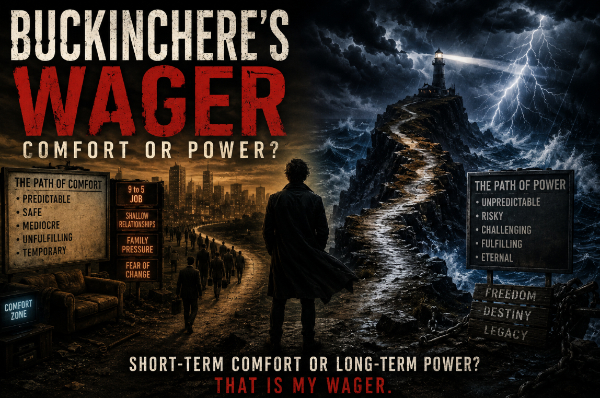
    With that said, I wager to you now, will you choose the fleeting comfort of crap jobs, and shallow relationships. Or will you instead venture out into the deep blue waters in search of total power, freedom, and your ultimate destiny?

    Short-term comfort or long-term power?

    That is my wager.

    © 2026 The Buckinchere Publication, SP.

    All Rights Reserved.
    As it relates to the article, do you choose comfort or power?
  • Blog 106

    Blog 106

    Ready.

    Why Should I Hire You? The Truth About Corporate Loyalty

    B. Lorenzo Buckinchere

    May 17, 2026

    Most people only seek jobs because they need money, and I’ll prove it!

    If you won the lottery on Friday night, would you go back to work on Monday morning?

    Probably not!

    Three years later, and they still wouldn’t know whether you are dead or alive.

    You go to work because you need money!

    And that is not inherently bad by itself. In fact, that IS the only rational reason why any sane adult should sell forty hours a week of their waking life to a corporation. However, I must warn you to remain cognizant of the fact that not everyone goes to work for the same reason as you.

    Some people don’t even need the job. They have a trust fund, or a wealthy spouse they can fall back on. In some cases, an Only Fans account. Nonetheless, they go to work for one reason, and one reason only.

    Power!

    Don’t think for one second that they don’t know the reason why most people show up for a job they hate. They know you only want the money. And precisely for that reason, their thought process becomes, “There’s literally a million people I could’ve hired, so why should I hire you?”

    Now first of all, it’s important to note that whenever they ask you that during an interview, no one really knows the answer. In fact, most job coaches will claim that you should “just figure it out,” because they don’t know the answer themselves.

    Claim, because they actually know the answer. They just don’t want to say it out loud because they know just how horrible it sounds.

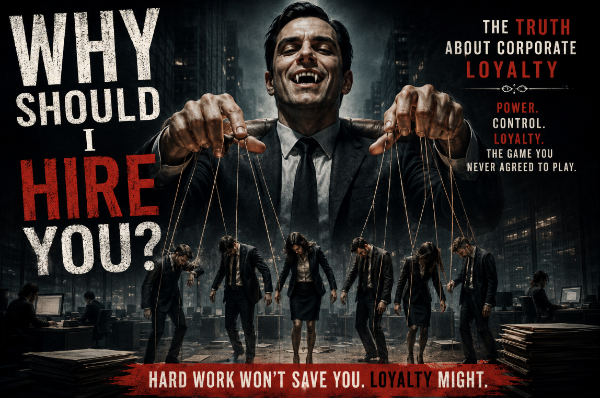
    If you are at the bottom of the proletariat looking for work, and there’s a million other applicants, all looking to replace you, then the only leverage you have over them is loyalty. That is the unequivocal answer to “Why should we hire you?”

    The trouble is that normies understand that concept perfectly well. Perhaps not in so many words, but they know the game. They know the script, and they’re willing to play.

    But playing the game in a sadistic corporation often requires turning a blind eye to injustice. Not simply turning a blind eye, but also joining in on the torment. Because people who care about loyalty only think in black and white.

    “You’re not allowed to be indifferent when dealing with me! You’re either for me, or against me! And you’d better not be against me!”

    Actually doing your job is only part of the equation. They really only want your loyalty. That’s why douchebags get promoted, and hard-workers get fired. At some point, your loyalty will be put to the test, and then it will become obvious to everyone involved, whether you are loyal to the job, or loyal to the boss.

    Those who are loyal to the boss get promoted, while those who are loyal to the job get rewarded with the work load of four different people until they figure out a good enough reason to fire you.

    Now for the record, I’m not throwing shade at loyalty. Loyalty is a beautiful thing when paired with love and reciprocity. But when it is as one-sided as it is within sadistic corporations where people only show up to fight over money and power like a pack of wild hyenas, then loyalty becomes equally sadistic. More than that, it becomes a weapon.

    Some people are built for that sort of thing. They like the taste of other people’s blood in their mouths, and the last time I checked, only vampires drink other people’s blood. So if you are not a vampire, then the modern American workforce is definitely not for you.

    But you still need money!

    You still need to survive!

    You need food. You need water. You need medicine. You need car fuel. You need extra cash in case of an emergency. And you still need to be able to pay rent, or you will end up living on the streets.

    Jobs are all about control, loyalty, and dogpiling on the quiet guy or gal who does their job, minds their business, and goes home. Corporations only see employees as pawns whom they can use and discard at will. And they make it seem that there is no alternative outside of their power games and one-sided loyalty. But I promise you, there is.

    If you don’t wanna get caught up in the chaos, and all you care about is getting paid to do what you truly enjoy, then join me next week as I discuss a rather interesting wager I’m sure you’ll find useful.

    Hope to see you then.

    © 2026 The Buckinchere Publication, SP.

    All Rights Reserved.

    As it relates to the article, why do you, dear reader, still seek employment in 2026?
    ×
  • Blog 105

    Blog 105

    Ready.

    Jobs are for Normies

    B. Lorenzo Buckinchere

    May 10, 2026

    And that goes for all jobs. White-collar. Blue-collar. Entry level. Professional. And everything in-between.

    It’s just that some normies were able to get into white-collar management positions because they were willing to lie, or sleep their way to the top, screwing others over on their way up.

    Either that, or the lot of their birth had afforded them the privilege to attend college. For those reasons, they are a little higher up on the societal food chain than others.

    But they are still normies for the very simple fact that they are comfortable with playing the hierarchy game while seeking to humiliate those who just want to quietly do their jobs and go home.

    A lot of the people with jobs don’t even need the money. They either have a trust fund, or a wealthy spouse. A job to them is nothing more than a chessboard for power. More on that later.

    If you are inherently creative, then by default, you are not obsessed with hierarchy, because you spend much of your time in your right brain, and creative energy tends to lean more feminine.

    For that reason, you cannot work a normie job. Not for long anyway. Because the opposite of a normie is to be neurodivergent.

    If you are creative, then you have neurodivergence by default, and the moment the normies spot that you are different, they will gang up on you and seek to ostracize you, and it won’t be obvious at first because they will appear friendly.

    But understand that that is the most important part of the facade. You catch more flies with honey than vinegar. By the time you are able to figure out that you don’t belong, it will already be too late, and you won’t be able to fight them so easily.

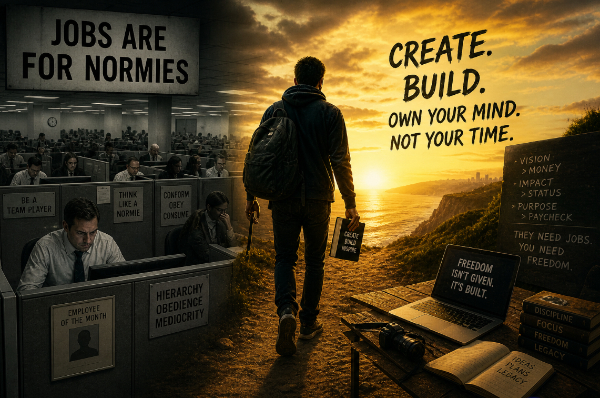
    And in fact, you don’t belong because you are not supposed to. You see, jobs are for normies.

    The typical. The average. The talentless.

    That’s why they fight to gatekeep their spaces from neurodivergents so ferociously. They figure it’s only fair because they need those spaces to survive, and you don’t.

    You can literally get up one day and decide to write a book, or build a website. They can’t! They need those jobs. And for every job that is occupied by a neurodivergent, that’s just one more job they figured could have gone to one of their normie friends or relatives.

    Not only that, but most blue-collar jobs are service level positions. We’re talking about; uber, Lyft, UPS drivers, Amazon Prime, warehouse associates, telecom tower technicians, etc.

    When neurodivergents create something meaningful and relatable, we need people to help us move it across town right to the doorstep of our paying customers. And that’s where normies come in.

    Why would you want to work among normies when they are literally meant to serve us?

    Sometimes, a shift in perspective is really all you need to help move things along smoothly. So with that, I close by reiterating my main point.

    Jobs are for normies.

    © 2026 The Buckinchere Publication, SP.

    All Rights Reserved.

    Neurodivergents should work a regular 9 to 5 job;